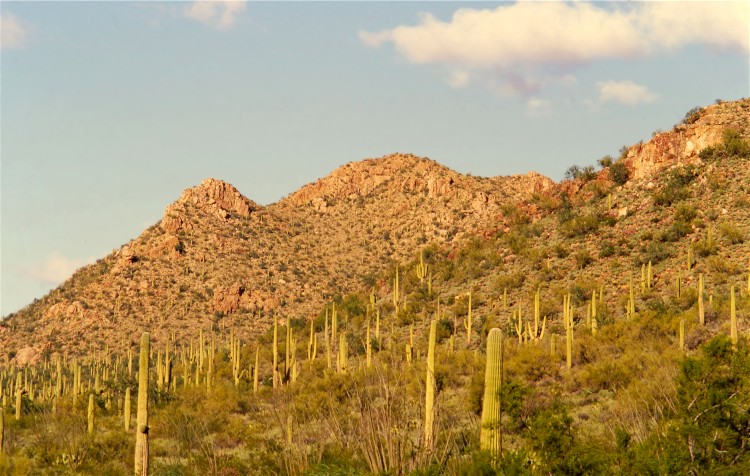
Known as the symbol for the desert southwest, the saguaro cactus is the standard by which other cacti are judged. It is a plant with a personality, derived from its appendages, as it assumes the human like shapes that inspire fanciful imagery. The saguaro cactus is the symbol of the Sonoran desert, which far surpasses all other North American deserts, as it is one of the hottest and driest deserts on the continent. In a typical year, the summer temperatures may reach as high as 120 degrees with fewer than 12 inches of rainfall occurring throughout the year. Yet, it is a very diverse community with several other
species of cacti, desert trees and shrubs, and animals and birds. These plants and animals are able to survive in this niche because of adaptations specially designed for desert living. Thus this ecological system is one of the most interesting and unusual in the United States.
The Sonoran Desert supports a variety of plants. There are over 25 species of cacti alone that compete for the valuable nourishment afforded by this arid environment. Some include the hedgehog, the barrel (several species), the fish hook, the cholla (3 species), and the prickly pear. The creosote bush is the most widespread of the trees in the Sonoran desert. It and the Mesquite trees provide shade for all the wildlife that are dependent upon this niche. Ocotilla and palaverde bush each sprout leaves shortly after a rainstorm, and then drop them as the moisture becomes scarce again. They then depend upon their green
bark to provide photosynthesis for the plant nourishment. Many desert
wildflowers bloom after the spring rains and the monsoons of fall.
Desert animals are adapted to this harsh environment. Most avoid the heat of the day by venturing out only at night or by sitting in the shade provided by the plant life around them. The desert floor is filled with holes in which many of the nocturnal animals, such as the cactus mouse, the kangaroo rat, and the packrat and tortoise live. Another of the nocturnal creatures are the 8 species of rattlesnakes. Most birds and several animals restrict their activities to the cooler morning and evening hours. Gambel’s quail and the road runners are most active then, as well as most of the other birds tend to feed at this time and rest during the mid-day heat. Many species of lizards, including the gila
monster, one of the two poisonous lizards of North America, and the desert tortoise also feed in the early mornings. Most animals that are out and about in the mid-day heat have special adaptations which dissipates heat. The rabbits (three species…cottontail, antelope jackrabbit and the black-tailed jack rabbit), all have oversized ears to do that job. The coyote, and the javelina find shade in which to nap in mid-day.
Desert creatures always deal with a shortage of water. The larger mammals search out water holes. Other animals have developed special adaptations for their need for water. The javelina get their needs fulfilled by dining on the juicy pads and fruit of the prickly pear. The kangaroo rat never needs a drink as it get 100% of its water needs from the seed it eats.
The giant saguaro cactus itself is like a giant high rise tenement house. Since it can grow to be as tall as most trees the upper stories are for the white winged dove which perches on top, and the gila woodpecker and the gilded flicker, both which drill holes in the cactus trunks and larger branches. These birds create new holes every spring, often reject several before accepting one for raising their young. These abandoned holes provides homes for other birds, who move in rapidly. These cavity nesters which rent these abandoned holes
include kestrels, Lucy’s warblers, cactus wrens, kingbirds, phainopeplas, elf and screech owl, an occasional purple martin, and honeybees. The holes are a retreat from the mid-day temperature extremes. Because of the thick walls, these homes are 20 degrees cooler in summer and 20 degrees warmer in winter than the outside temperature. The arms of the saguaro, provide areas for the Harris hawk and the red-tailed hawks to build the bulky stick nest, and a place for the gray fox to get an elevated view of his territory. The pack rat digs a tunnel under the base of the large cactus and then disguised its home by covering it with sticks and stones. The cactus mouse and the kangaroo rat can also be found
living in the basement of this tenement house.
The Sonoran desert is definitely a place unique in its ecology. The life that depends on these giant cactus is fragile and intricately dependent on the cactus itself as well as all the other species mentioned. The most fragile part is the water supply, and then the pollination, and seed dispersal. The waste products of the animal life and the death of plants and animals provide nutrients for the cactus. The diggings of the rodents and tortoise oxygenates the soil. Each creature that uses the cactus also provides for the cactus, making a very intricate balance in the saguaro ecological system in an arid hot desert.
Photo by Wayne Neslon
 Earth Images Blog by Wayne Nelson
Love your Arizona pictures. I’m. From phoenix and am looking for a guy by your name from east mckeesport Pennsylvania. Born on march 10. If your him would love to hear back from you. I miss Arizona so much….
I thank you for your comment on my images from your beautiful state, but alas I am not from Pennsylvania.