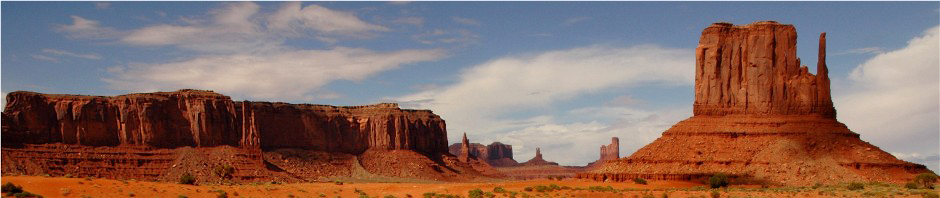
In the future I will occasionally include blog images that I find less than perfect. It is the right way to discuss some of the issues we all face when we make pictures.
Seasons come and seasons go. Before you know it, spring will turn into summer. I’m not trying to rush our seasons but it is inevitable. When summer does arrive so will nature’s littlest creatures. The best subjects to start with are caterpillars. Along with snails and slugs they are the slowest of the slow. It is however a mistake to think that they will not move during your exposure. This one did not move and I thanked my scraggly friend and moved on.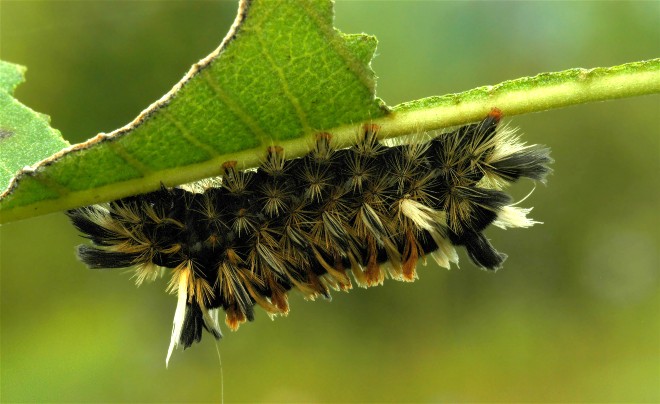
With summer comes dew. Is it possible to have too much dew? To me that is in fact impossible. A chilled and dewy insect does however present it’s own set of problems. First of all you have to be willing to get up early. Dew arrives over night and the morning sun will diminish dew very quickly. I used my preferred method for the image below. Late in the afternoon on the day before I made this picture, I searched for spots with a lot of dragonflies or butterflies flying. In that area I found a low lying spot near a river. I returned the next morning just after making another Lake Michigan sunrise. It took me maybe 15 minutes to locate this very dewy dragon. After creating photos of the dragon below, I located about 5 more to work with. With low light levels, a tripod is the only professional way to handle this sort of job. The biggest issue becomes how to eeeeease your tripod into place without knocking the dew and/or the insect off of its perch. In fact I have done that while I was still 15 feet from the insect. In a grassy meadow every piece of grass will touch another. And so on and so on. You get better at performing this task every time you do it. The second issue with critters that are heavy in dew like the one below, is that you need lots of depth of field and perfectly tack sharp images. The depth of field is to cover the “bumps” of dew. The critical sharpness is because heavy dew actually can make an insect look fuzzy. The dragon below was photographed with my Nikon 105 Micro lens, and a sturdy tripod with legs that split so you can drop it to near ground level.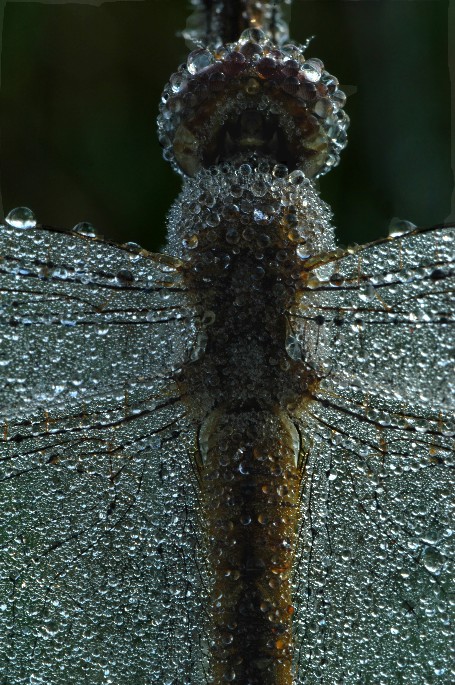
One of the things I love about landscape photography is the ability to make good use of extra wide angle lenses. The challenge is to include all of that real estate in your image, and then bring order to all of the chaos. Still the challenge of doing telephoto “scapes” is also large. Using 200mm+ telephotos to visually compress your subjects can be a stimulating exercise. In the semi abstract picture below I used my 500mm f4 wildlife lens to create maximum compression. It was made in the Grand Tetons of Wyoming and it was all about the color and texture of the foreground hill against the immense snow covered mountain, and then bringing them together on one plane. I’ve written before about the fact that you do not always need to use the most expensive brand lens such as Nikon, Canon, Pentax. To have a big lens that you can shoot at f22 and still retain sharpness and high resolution, does require the best of the best. Super telephoto lenses are made to shoot mainly between f4 and f14, and only the best work well when stopped down for maximum depth of field. 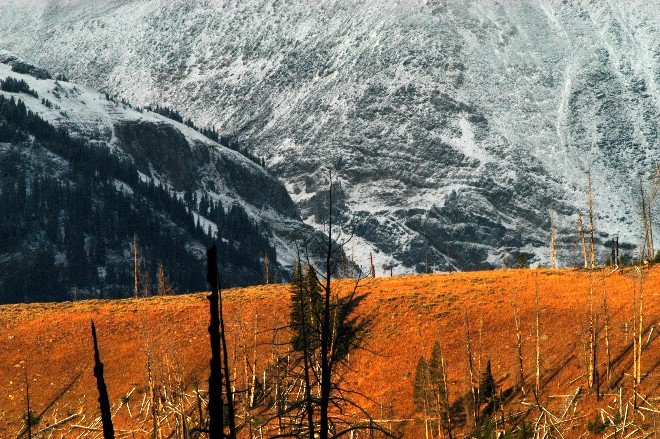
The preferred way to “shoot the moon” would be to incorporate the moon in a landscape photo. The issue has always been, how to keep detail in (taken at-sunrise/sunset/silhouette) the moon so it won’t be a blank white disk. In other words keep detail on the surface of the moon, while showing detail in the much darker landscape. Back in the day I solved this by making double exposures on a single frame of 35mm film. One shot of the land, and one of the moon. I would also sometimes take a whole roll of film of just 100mm to 200mm moons. I would then shoot a series of landscapes over the same film. My moon shot would be in the upper right or left hand corner of the frame, and my landscapes would have open sky in that same area. This technique can of course be used with non moon images as well. On another occasion I made a single 20 exposure image. I created an image of a field of flowers. I continually moved my tripod a fraction of an inch to the right and made 19 more exposures. My exposure was calculated by taking an incident (hand held) meter reading and mathematically dividing that exposure by 20. That was my repeated exposure for all 20 images. This can be done with many of today’s digital cameras. That’s all a lot of work and the photo below is a straight up image of the moon. I exposed for the moon in order to keep some color and detail. That underexposed the dark blue sky and turned it black but that was perfect for what I wanted. I used my trusty 500mm f4 lens and a Nikon 1.4 converter. With my digital camera that made for an over 1000mm image. I then cropped a bit as well.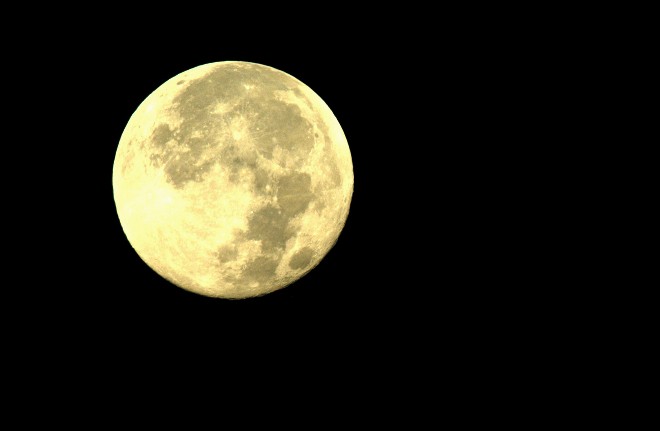
Attempting to make a compelling landscape when your subject is backlit is a frustrating experience. When I discovered the rock (I love rocks) below in Big Bend N.P. Texas in early 2006, I knew I wanted pictures. I could not expose for the land without bleaching out the sky. Today I would bracket 3 exposures from under to over exposure and combine them in High Dynamic Range (HDR) software. Care must always be taken with HDR imaging as cartoonish overly colored images are possible. As I look at the picture I do think I could save it by using the magic wand to highlight just the sky, then reducing the exposure there dramatically, saving the file, and then increasing the exposure on the whole image. This also sounds like a lot of work. I loved those “good old days” when my photography was finished when I clicked the shutter. Of course the photography itself was twice as hard with so many limitations.
In my opinion there are some serious compositional problems with the aforementioned Big Bend Scape. The round boulder is the beginning (and feature) of the picture. It is significant in this image that I either included the entire round boulder, or only a small section of it. Cutting off the left side throws the entire image out of balance. It is unsettling. I would also prefer to see a bit more empty space in the upper right hand corner of the image. The peak of the hill leans in that direction. If it leaned to the left it would work the way it is. In my defense I made this picture after going without sleep for almost 3 days. This location is also mid way through an 8 mile hike. I know! Excuses, excuses!
All wildlife photographers have a species that has frustrated them for years. The Black-bellied Plover is such a bird for me. Oh I have lots of pictures of these birds. The problem is they are all in winter plumage as you see below. This bird is gold, black and white in the summer, and it is gorgeous. I had one opportunity in Columbia County in Wisconsin a few years back. Four beautiful birds. Well out in the marsh but a nice view through the spotting scope of a friend. This was a time when I wished I was set up for digiscoping. Two hours later they finally flew away without a close approach. Oh well I have several hundred images of non-breeding birds.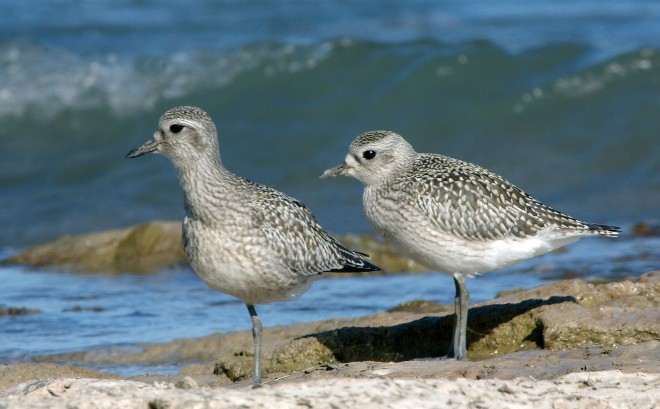
The Trumpeter swan is one bird that I have never had a problem, finding or photographing. Usually up close. This bird is endangered in the Midwest and was re-introduced in Wisconsin. The image below shows off the long neck just as I waned it to. It still would have been a stronger comp if the bird had tilted its head a bit toward the camera. The narrow vertical view of the bird’s neck, and the horizontal profile of the bill, conflict with each other. I have hundreds of Trumpeter pictures and could have chosen another picture but I found this one and decided to make an example of it.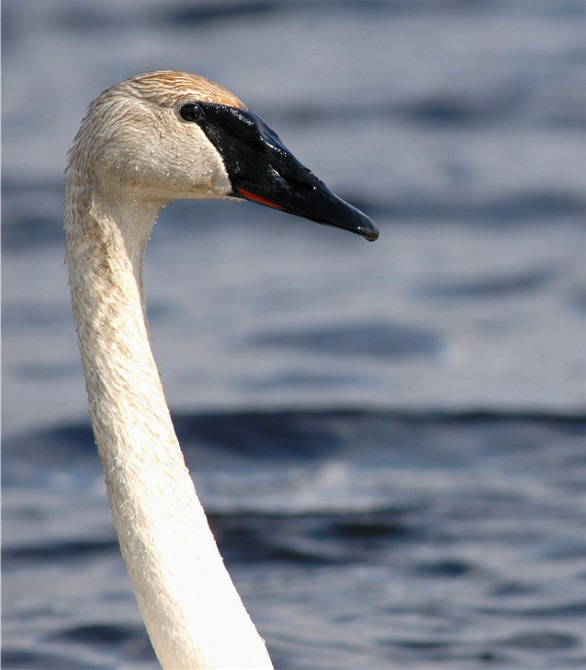
The Eastern (and Western) Meadowlark has also treated me well over the years. Most of my images of this species are the traditional (and desired) male in song pictures. Every once in a while one will give me something a bit different. Such was the case with this old picture made in Wisconsin. I love the comp and the clean blue background of this image. The extreme upward angle of the shot is however, uncomfortable. I was unable to get to eye level with this bird and would have preferred to shoot absolutely straight up at my friend. It would be acceptable to view a bird at this angle if you are looking at its belly.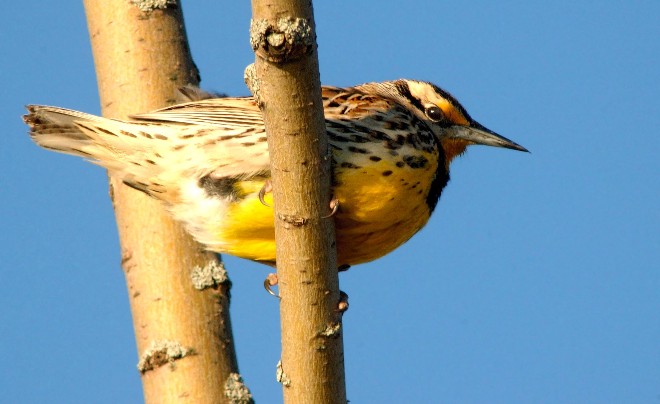
As I finish re-reading this post, I realize that it is getting closer to the time when I will need to stop writing them. I have enjoyed being back at the keyboard, but I knew the time would come to stop. Maybe for a while I will simply post pictures. We will see.
I always appreciate the fact that you stop by and visit!
 Earth Images Blog by Wayne Nelson
I have truly enjoyed you being back at the keyboard…you know how to tell a great story and you have shared your knowledge so that we may continue to learn.
Whatever it is that you decide…God Bless you Wayne
I appreciate your support. Great friends like you are hard to come by.