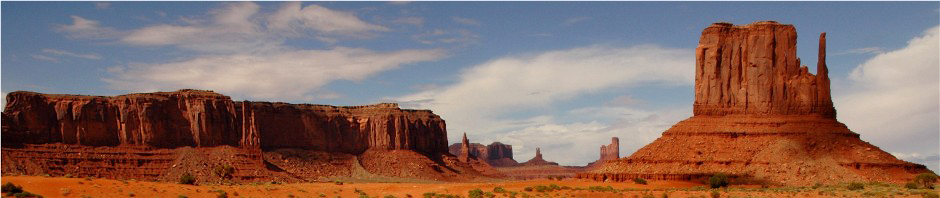
I’ve created and shown my share of photos that were made as I hung over the cliff at Colorado’s Black Canyon of The Gunnison. That river is a long ways down and in fact, in some locations it is a mile from top to bottom. On my final trip here in 2007 I decided to repeat a drive that I had made down to the river in 1986. I am not sure what the steepness or % of the grade is here, but it is steeper than any public road I have ever been on. To my delight and dismay, the road had been paved since my last journey. It was a smooth trip down the side (literally) of the mountain. As long as the road is dry, and your vehicle runs well and possesses good brakes, anyone can now take this drive.
From the top.
I was enjoying my day at the top of the canyon and was looking forward to photographing the sunset from the edge of the canyon. That meant I scheduled my trip down to the Gunnison River at high noon. Contrasts were high but I knew I would never be here again, so I worked with the light and did what I could. I settled on a few river shots and a couple of pix of a small canyon at the bottom. Those results are below. I also stretched out near the river for a few quick winks of sleep. It was not to be, as I spotted a Bald Eagle just down river. He was in backlight so I never really made a viewable image. My mid day adventure “down by the river” was not profitable as a photographer, but it was still worth the trip.

One day at Horicon Marsh NWR, I was fortunate to happen upon a male Sandhill Crane dancing and strutting for his lady. I made a fair amount of pictures in different postures. You see one below, but just what is wrong with this picture? The upper beak merges with the neck of the other crane. When you view this image from close, the beak and the other bird are clearly separate, but when viewed a little farther away, at the proper distance, it blends with the other crane. Merges are always a potential issue in photography. So much to think about when making pictures. That fact is what really makes photography fun.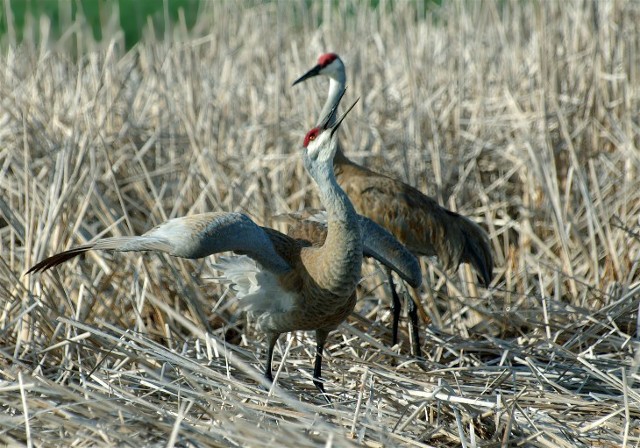
Sandhill Cranes photograph very different in different types of light. They can go from pale gray to rich browns and rust colors. Whatever subject I am photographing, the color of light and how it affects my subject is of primary concern.
These are clearly marsh images of a Sandhills. I have met photographers who think that Sandhills are prairie herbivores. We find them so often in fields feeding on grains, that newer non-birder/photographers don’t realize that they generally raise their families in marshes. They also spend their nights in water or small islands. They not only will eat a fish or a frog, but they will eat the eggs of other birds and I once saw a juvenile Sandhill catch and consume a mouse.
Whenever possible use your point of view, and I mean literally the point that you view your subject from, to impart the mood you hope to convey. It should be intentional and a part of your thought process, especially when creating landscape images. I absolutely wanted the viewers of this image to hold this unusual and beautiful rock form….in high esteem. When someone or something is taller that you, you look up to it.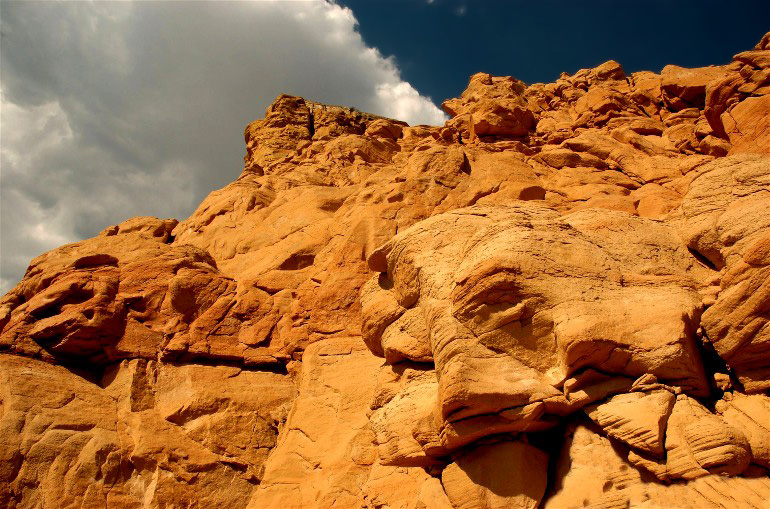
I love thinking about and executing the act composition. The word composition in photography means that you are in fact, the composer of your imagery. Who wouldn’t want to be a composer.
I enjoy the process behind composing flower pictures even more than landscapes. There are many ways to compose any given flower. I fell in love with the shape, color and texture of the blossoms you see below. Most of all I enjoyed the way the light partially penetrated the flower. Sort of semi-translucent. I made a decision that this was not the flower for abstracts. I had been shooting abstracts almost all morning and I wanted to pay homage to these flowers by letting the world see just what I saw. I eventually moved in a little closer for more detail. When I was done I felt that I did my friend justice.

The great thing about nature photography is that you always have a partner. You do right by them and they will return the favor.
Cultivated flowers are always a good photographic subject. Add a black metal garden edger then all that is left is to simplify or better said, clarify what is in front of you.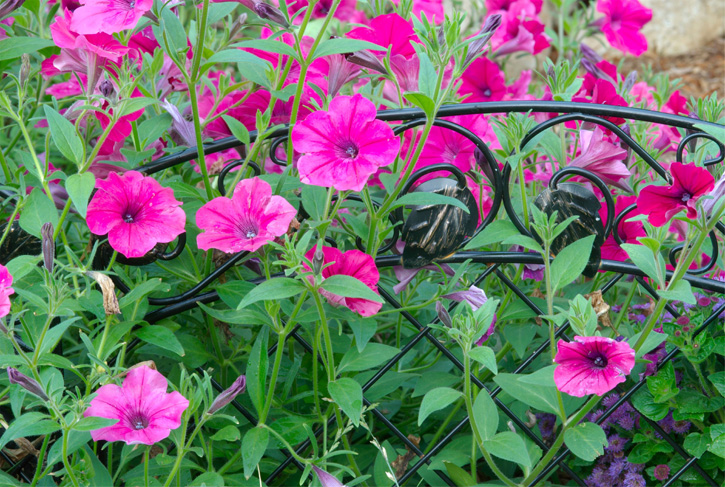
I took me many years to get close pictures of American Kestrels. Like with all nature subjects once you understand them they become an easier photo subject. These are smart little predators. A few years back I had a Kestrel in near-by farm country that recognized the car that I drove as well as me. As long as I was in that car he did not fly from me. If I switched cars he would fly away and look at me from a distance. Once he recognized me I was once again allowed a closer approach.
I am a believer of not only thinking about the picture we are about to make, but analyzing the images we have previously made. Both fit the subject below.
A bee, a flower and a summer’s day. Yes this shot was completed with the aid of a flash. The dappled sunlight streaming through the trees created a very contrasty flower, and bee. The background was quite a distance in back of the flower, but was still a bothersome combination of contrasting tones. I was able to lower the contrast on the foreground by using flash. This filled in the shadows and evened out the entire foreground scene. The fast exposure for the flash produced under exposure on that bothersome, but distant background. That reduced the visible detail almost completely. I now had a low contrast foreground and a low contrast background. The background and foreground were however very different values. That meant that there was great contrast between the foreground and background. That produced pop. Exactly what I wanted.
In review, what I did when I made the photo above, was to reduce bad contrasts, and increase the good contrast that made the image appear crisp and eye-popping. If the entire scene would have been lit in low contrast natural light, that is what I would have opted for when I made the picture.
The condition of dark backgrounds with well-lit subjects is created naturally by Ma Nature all of the time. I was always on the look out for subjects in the sun with shaded backgrounds. Those backgrounds are generally small and unnoticed by many photographers. A change in your angle or point of view, and/or a longer focal length that can narrow down that background, and walla, you are taking advantage of something that nature provides for you. Naturally of course.
Spring will soon arrive and with it, so will the Tulips. They are early bloomers and a weathered old stone wall is just what they needed to become something special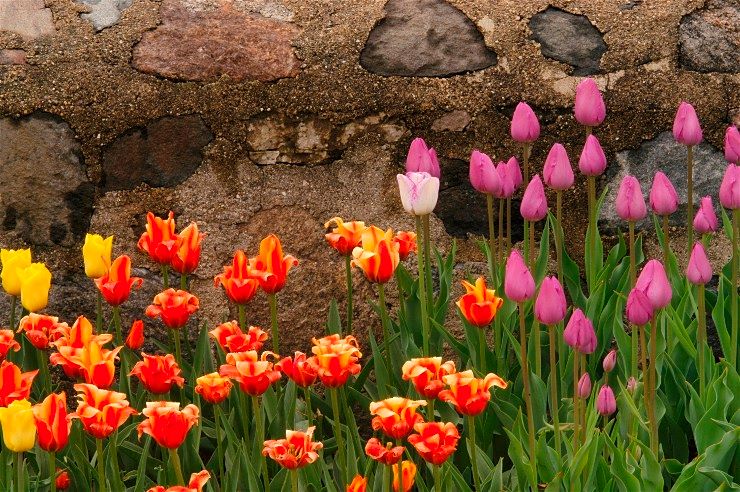
On occasions I have written detailed information on the basics of photography, such as exposure, reciprocity failure as it relates to film and if it relates to digital, complex use of electronic flash, multiple exposures, the use of filters and more. I have never touched on the use of the histogram in digital photography. The best explanation for this is that I do not use the histogram. I used it in the early 2,000s for a while, and a bit in 2007 and that is it. I suppose that seems contradictory for someone who claims that the techniques and technology of photography are just as important the art. While histograms are about exposure, they are not at all about understanding what exposure means, or how you can learn to arrive at the perfect exposure. If I told you that many of the world’s premier nature photographers do not use the histogram, would you believe me? It is true. Many of those same photographers go back to the days of film and are masters of exposure.
Having said all of that, a very basic look at the histogram is warranted.
A histogram shows the shadows and the highlights of the pixels within your image. The middle of the graph is mid-toned. In other words neutral or 18% gray. So from almost black on the far left, to almost white on the far right. Understanding what mid-toned means, and visually placing that value where you want it while you are creating images, and then realizing where the shadows and highlights will fall, is far more useful as far as making the photograph you want.
A histogram in and of itself, cannot teach you how the blending of shutter speed and lens aperture obtains an exposure. Yes you can ascertain facts from a histogram that can then teach the blending I spoke of, but ultimately it doesn’t tell you how to creatively make those adjustments. It can actually become an exposure crutch and stifle creativity.
The biggest positive from a histogram is the ability to show image clipping. That means areas completely void of detail. That would suggest a shift in exposure. The truth is that any high contrast scene has a limit to potential viewable detail. Using graduated filters or creatively allowing some areas to become shadowy, is your best bet. With “blown out” areas the graduated filter is especially useful. It will allow you to retain some detail in the brightest area. From there, selective darkening to that area with software, will bring the overexposed spots back to mid-toned. You can do this with most software programs. I am not one to suggest that you just make the picture and fix it when you get home, but doing this allows you to place your mid-toned value where you want, and save that one blown out area for when you get home. It is true that incorporating the histogram in your software editing can help you fix that image, but is that as good as knowing what you want, and visually creating the image you had hoped for in the first place? I think not.
Histogram or not, the important thing is to understand what all camera meters are looking for when you take a reading, and making sure you know what you want the mid-toned part of your image to be. Learning to use a histogram without that skill is meaningless.
If you choose to use your histogram, whether it is while you are in the field, or at home, please remember that except for blown out areas that are void of detail, they are a matter of opinion. That’s exactly why understanding exposure and knowing how to get what you want, will always be more important than a graph.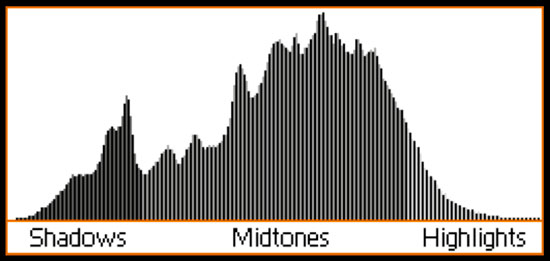
I haven’t written much recently about my favorite nature photographers of all time. In my recent articles I have tried to stick to writing about today’s top photographers. I do however enjoy looking at my all time best.
My favorite current nature/all around photographer has now also moved up to my best of all time. Art Wolfe exhibits the spirit, humor, skill, art and attitude that most of us can only wish we had. He photographs everything including non-nature, and creates artistic imagery in many different styles. He is forever young and has a humble and unassuming way of living life. He is a nice man and a great artist.
The late Galen Rowell lived with the spirit of the wild. He was an athlete and a true adventurer. His landscape art was incredible. I never knew a photographer (yes I did know him) or anyone else who understood the color and quality of light like he did. Unfortunately he is slipping from our memories. Today I imagine today’s photographers would say, his colors of Mountain Light are not nearly as spectacular what I see with other photographers today. Virtually every day on Facebook. The colors of nature have not changed. Color enhancers, HDR imaging and the saturation button do bring more spectacular colors to today’s images. With Galen you could count on the fact that he really did hike 40 miles and stay up all night to capture the essence of the true color of light. Sometimes settle for less so you can see more.
John Shaw has been the greatest teacher ever. His books on nature photography have been the only true money makers in that field. Despite the fact that these film related books are outdated, they can still be found in bookstores worldwide. He taught us how to discipline ourselves to create perfect images. He did this while leaving us the room to artistically interpret those same images. I began buying nature photography books after I was already a very experienced professional photographer. I did this because I enjoy photography and what photographers have to say. I rarely really learned anything from those books. Galen Rowell’s Mountain light did teach me adventure, and every one of John Shaw’s books taught me something, no matter how much I thought I knew.
From David Muench to Frans Lanting, and from the Gerlachs to Pat O’hara, there have been many greats, but I would put my top three against any list anywhere.
If you are interested in varied types of photographic artists, you may want to try
DeJa Vu all over again?….as Yogi says
I was just listening to a morning radio show, and the show members were relating all of their stories about the different apps on their smart phones and tablets. Finding the cheapest gas, reading their favorite magazine, faster uploads, games. I know I should be interested but I’m not.
In about 1994 I kept hearing about how many people now had computers, and then there was this thing called the internet. I realized that viable photographers participated in this thing, and had websites. I capitulated and there I was. Computerized and on the World Wide Web.
Why is it that I not only don’t care that I am not using apps, I feel free? More free than the world around me. I am certainly not sad that I joined the 20th Century back in 1996 or 97, but I am not participating in this round of the 21st Century. Maybe my time has finally both arrived and passed.
Have a great day and God bless, Wayne
 Earth Images Blog by Wayne Nelson