The mammal images below were plucked out of a variety of different folders, and they were chosen by throwing a dart at the wall. Well not really, but the pictures and the subjects were chosen for no particular reason.
I’ve shown somewhere in the neighborhood of 400-500 different images of Red Foxes between my old website, this blog and varied social media and websites where photographers can post photos. All of those images had something in common beyond be of Red Foxes. They were made between 2008 and 2011. I did in fact, photograph two different foxes before that time period. Both were photographed on film in the 1990s. The fox in the first two images below was photographed on Kodak Elite 100 in Agaziz NWR in Minnesota. He was hunting in the marsh. The second photo is something I have almost never done, and that is to alter the reality of a wildlife image. I converted this scan to b&w and then created a software produced Sepia finish. I must have been bored when I did this but I have to admit I don’t mind the results. I scanned both of these shots around 1999 or 2000 and they have languished in a folder ever since. The third image is a digital original made in 2009.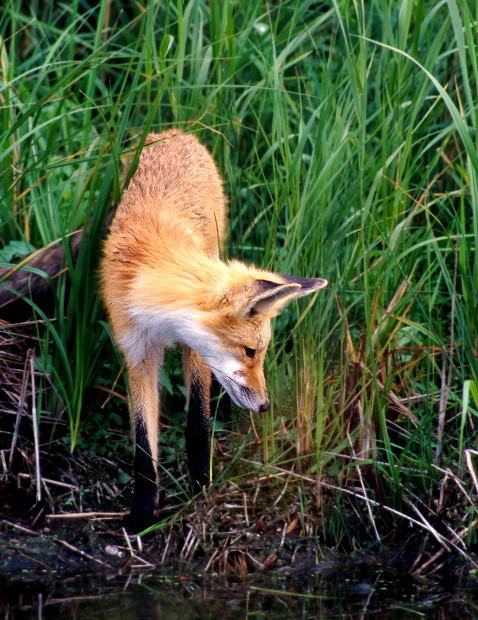


My favorite North American herd mammal is the Pronghorn. I love the African feel of these guys and when they turn on the afterburners, they are supersonic. First we see a group of young females in Yellowstone, then a father and son playing hide in seek at the same location, and finally “The King” in northern Colorado.


One reason I call the fellow above the king is…well…that is what he was. Nobody even attempted to dislodge him from that position. Also I think that beautiful set of horns sets him apart as well. Pronghorns have horns as the name suggests, not antlers. Both sexes have them although the male’s are bigger and they grow them younger. They never shed their horns. They do develop a thick coating of hair over them and that is shed once a year. Many people call Pronghorns antelope although they are not a part of the family of any current antelopes. That is why I never use the antelope moniker just as I do not call Bison, Buffalo. I do however call Mt. Goats by that name despite that they are not goats and are related to “actual” antelope, and I call Bighorn Sheep by that name despite the fact that they are actually goats. I use those terms because Mt. Goat and Bighorn Seep are the names that they are officially called by.
This North American hoofed mammal is the sole surviving member of the family Antilocapridae (order Artiodactyla) of Africa. It is also called the Prongbuck, Pronghorned Antelope and American Antelope. It is not related to the Old World antelopes. The slender, graceful, Pronghorn has a deer-like body weighs between 90 and 125 pounds, and stands about 3 1/2 feet at the shoulder. It has large, protruding eyes and a white or buff, 4-inch tail.
I think most photographers looking for herd animals in Yellowstone N.P. would agree that the most majestic is the Rocky Mt. Elk. We see a variety of shots from that location starting with a bull and a cow, then a cow and a calf, and finally a pair of shots of a young bull. His harem consisted of two cows. He’ll get better at it.


It’s always good when you photograph Bighorn Sheep and don’t have to climb to reach them. South Dakota’s Wind Cave N.P and Custer State Park are a good place to accomplish that. The rams you see below were photographed in Wind Cave and the youngsters at Custer.


Over a good portion of North America the most common large mammal is the Whitetail Deer.
The first shot below is of a couple of “young bucks” and was made in northern Illinois.
We are all after that cool shot of the 14 point buck, but I have always chased anything interesting or unusual with Whitetails. I rounded a corner at Sandhill State Wildlife Area and found this doe wading chest deep in search of some yummy water-soaked vegetation. I managed about 10 shots. I have actually seen deer in the water many times, but this was the only occasion that pictures resulted
Grazing/browsing animals really do prefer wet vegetation. We all know about moose but my many years with horses showed me many examples of that species soaking their hay in a water bucket before eating it.
I know birds are not supposed to be a part of this post, but a deer and a Cowbird? The hitchhiker was of course picking ticks and other small insects out of the fur of the deer. That’s something I am sure the deer was happy for.
Small mammals are my favorite wildlife subjects and over the years I have photographed my share.
My all time favorite is the Thirteen-lined Ground Squirrel.
Young mammals are always playful and opportunities to show that are gratifying. Caught these young Yellow-bellied Marmots in Colorado.

I have seen North American Beavers over much of the U.S., but only a couple of opportunities for photos have resulted. This silt covered beaver was photographed here in Wisconsin at Crex Meadows Wildlife Area.
Horicon Marsh NWR here in Wisconsin has brought many birds to my cameras but it is good for mammals too. Got this River Otter crossing Federal Dike Rd.
Along the side of the same road we find a different animal. Raccoon.
A little more rare, even out west is the Javelina. I photographed this one in Big Bend N.P., Texas.
I rarely show photos of captive animals but it is unlikely there will be any opportunities for Red Kangaroos coming my way. This zoo critter started bounding across the yard at just the right moment.
I am sure that many of you are surprised that I have not commented on the horrific tragedy of the grammar school killing of 20 children and six adults. I know I am opinionated, and I would normally give my take on both the murders, and the political grab game that I knew would happen afterward. I don’t have the energy this time. I have even stayed away (for the most part) from the places I visit where opinions on current events are the norm. I feel horrible for the families of all those left behind. My heart aches for all of those children who will never get to experience those things in life that all of us have enjoyed. One only has to watch the nightly news to know we have a country full of “experts” who have plenty to say….so this time I am speechless.
I thank each of you for visiting Earth Images. There of those who have followed me through success, and remain with me today. Please don’t ever think I am taking any of you for granted. You are very much appreciated.
 Earth Images Blog by Wayne Nelson