I have had some great times over the years photographing this beautiful species. I admit however, to more photographic failures than sucess. I have had either limited success or complete failure in the locations below. Michigan’s Upper Peninsula, Crex Meadows State Wildlife Area, WI, Squaw Creek NWR in Missouri, Illinois Beach South State Park and my own front yard. My only consistent location was a yearly nesting site which was in suburban Milwaukee in a community called Franklin. A couple of years ago the Wisconsin DNR wisely moved the nesting platform further back into the marshy area. It is a hard to access this location and it made it difficult for overly aggressive birders and photographers. Those last two species were really the only enemies that these birds encountered.
Over a three year period I spent many a morning with these guys. On my second year I viewed the Osprey from early spring nest-building/repairing, to relationship bonding, through sitting on eggs, feeding babies, babies fledging and finally one chick catching a fish. You feel like you are that uncle that always comes to visit and always makes mention of how those kids have grown. Most other photographers can attest, that regardless of lighting conditions, this was an extremely difficult place to make good pictures. It seemed like no matter when you were there or where you shot from, the light did not work well with the birds. I can count on my fingers and toes all of the good images I created here. Not a lot for all of those mornings. Just the same I wouldn’t trade a minute.
I do not know if they were the same birds all three years. My first morning visit of my third year I parked my car as always, across the street in a farm field, and a good distance from the nest. As soon as I got out of my car I was buzzed by an aggressive male. He came within three feet of me. Nothing like this had ever happened before. I was shocked. I got back in my car so that the Osprey would calm down and I realized why this male’s aggressive tendencies were so high. Another male came flying in from the east. They went into an amazing aerial display of combat. Unfortunately the sun had not even reached the horizon yet and no pictures were made. I returned a few weeks later and there was a male and a female tending to nest repairs
Nesting Osprey from this area migrate to South American in winter. First year birds wait two years to return. The best location (I believe) for viewing Osprey in North America is Florida. They have a non-migratory population and they often nest next to shopping centers etc. Just think how strange all of this is. These northern nesting Ospreys make that long yearly migration to South America, and often fly right past the Florida Osprey. If they ever take a moment and talk to those Florida birds…….
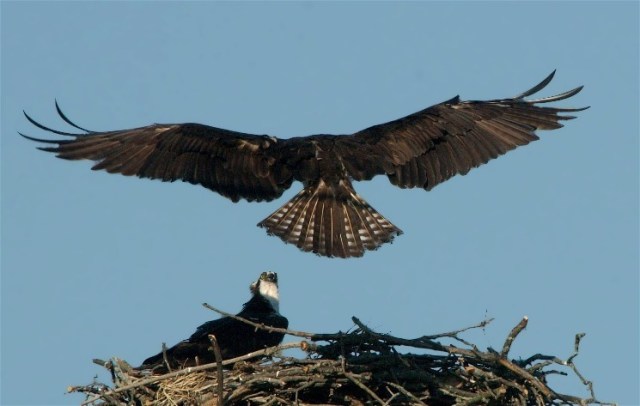
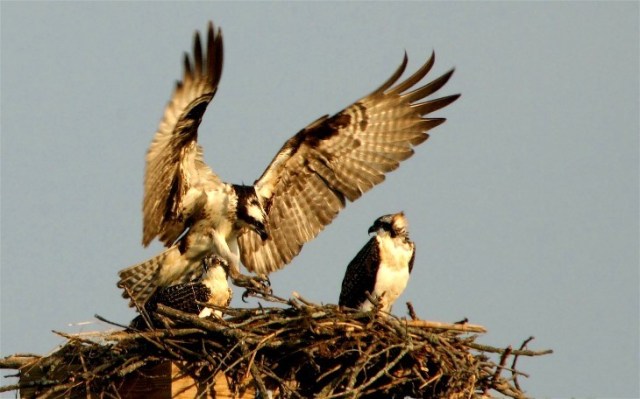
Below are a few pix from “the Franklin Osprey”.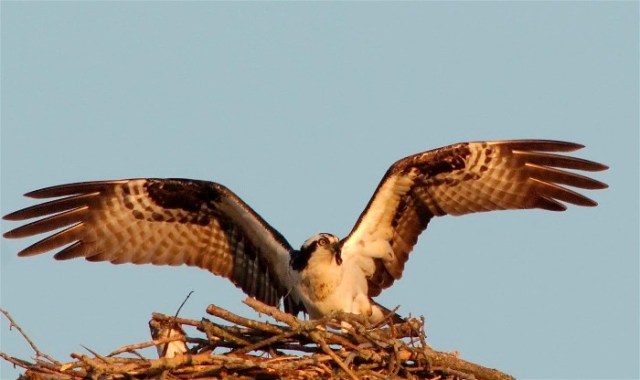


About Osprey: From the All About Birds Organization
Unique among North American raptors for its diet of live fish and ability to dive into water to catch them, Ospreys are common sights soaring over shorelines, patrolling waterways, and standing on their huge stick nests, white heads gleaming. These large, rangy hawks do well around humans and have rebounded in numbers following the ban on the pesticide DDT. Hunting Ospreys are a picture of concentration, diving with feet outstretched and yellow eyes sighting straight along their talons.
Size & Shape: Ospreys are very large, distinctively shaped hawks. Despite their size, their bodies are slender, with long, narrow wings and long legs. Ospreys fly with a marked kink in their wings, making an M-shape when seen from below.
Color Pattern: Ospreys are brown above and white below, and overall they are whiter than most raptors. From below, the wings are mostly white with a prominent dark patch at the wrists. The head is white with a broad brown stripe through the eye. Juveniles have white spots on the back and buffy shading on the breast.
Behavior: Ospreys search for fish by flying on steady wing beats and bowed wings or circling high in the sky over relatively shallow water. They often hover briefly before diving, feet first, to grab a fish. You can often clearly see an Osprey’s catch in its talons as the bird carries it back to a nest or perch.
Habitat: Look for Ospreys around nearly any body of water: salt marshes, rivers, ponds, reservoirs, estuaries, and even coral reefs. Their conspicuous stick nests are placed in the open on poles, channel markers, and dead trees, often over water
Field Marks Osprey Adult
Large and lanky raptor
Long wings mostly dark brown
White crown and throat with dark stripe through yellow eye
Sharply hooked black bill
Osprey Adult female specifically
Distinctive facial pattern with bold black stripe through eye
Sharply hooked black bill
Glowing yellow eye
Females usually show dark necklace across white breast
Similar Species:
Ospreys are the only large raptors with extensive, unmarked white on the belly. Immature Bald Eagles may be extensively mottled with white on their dark brown bodies, but they don’t show the Osprey’s clean white underpants, and young Bald Eagles don’t have white heads, either. Bald Eagles are much stockier and heavier-bodied than the lanky Osprey. Red-tailed Hawks are have much stouter, broad wings (without the Osprey’s kink at the wrists) and a shorter, broader tail. Though Red-tailed Hawks usually have pale underpants, they’re streaked with brown, particularly across the belly. It’s also rare to see a Red-tailed Hawk going after fish; they stick primarily to mammals. Turkey Vultures are all dark, and when soaring high in the sky, their long, broad wings are straight rather than kinked
Find This Bird: Near open water with an abundant supply of fish, listen for the Osprey’s whistling or chirping calls overhead, or look for this bird’s distinctive flight profile and heavy wing beats. From spring into fall, a boat or raft on a lake or river can provide an especially good vantage point. Scan treetops and other high spots along the shore for perched adults and untidy stick nests piled atop a platform, pole, or snag out in the open.
Regional Differences: None in North America.
I thank you for stopping at Earth Images
 Earth Images Blog by Wayne Nelson