When I write about photographing old buildings, I rarely mention photography of the interiors of those buildings. They all have an inside and I would suggest if you have the opportunity to make pictures there, take it.
When your interior has windows and it is a sunny or high bright day, it can be both a curse and a blessing. That light is usually exploding into the room. I generally use 1% manual spot metering. I appraise the room, and pick the spot that is mid toned. Between that bright window and the darkest place in the room. That takes experience but it comes faster than you might think. If you read from the window, the light coming into the room will be gray. If you read from a dark shadowed corner, the window will be so “blown out” as to be bothersome. Remember, meters want everything to be mid-toned.
The interior images below were all made with slide film, well before the advent of digital photography.
This first image is of a room in a 19th century farm-house and was the most difficult of the three. The fact that the room was mostly light/white helped. I took my reading from the area to the left of the window. I metered just above that bright spot on the wall, right next to the window. It was and is the mid-toned section of this scene. I had no problem with losing detail in the floor. If this was a commercial job I would have toned the window light down further and lit the floor and the wall separately with either photo floods or reflectors. The great part of shooting for ourselves is that we can interpret the scene however we choose.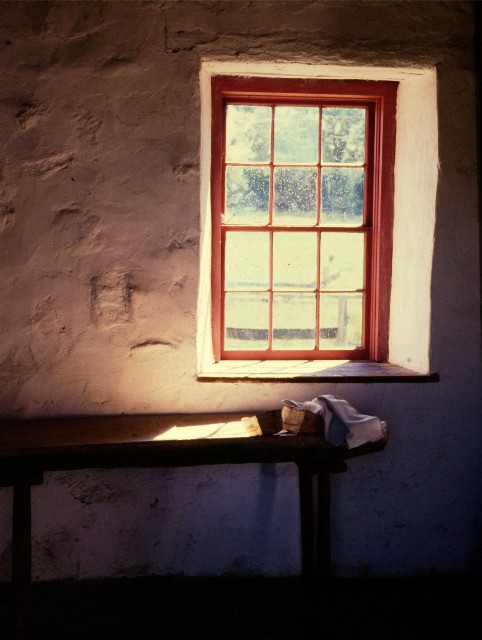
My 1% spot reading was made from area above the blackboard in this old classroom. I like the airy feeling of the tired old room. Again I lost all detail in the window area, and that is okay with me. Much work would have had to be done if this was an assignment. Reflectors would have been employed. If this was created commercially in the digital era, a lot of time would have to be spent at the computer. Thankfully I only need to satisfy my personal taste and I like the mood.

This stained glass church window is very different from the other two images. The window with its colors was not as bright as the other two. I only wanted some limited detail in the area around the window. The reason for that was I did not want a window floating completely in the darkness. I felt that taking my reading from the most mid-toned point of the image would lighten the window beyond the point of detail. Instead I took my reading from the window itself and opened my exposure up about 1 ½ stops. The results are just what I wanted.
Why do I remember what I did with these pictures when I show some photos that I don’t even remember making? In the slide sleeve pocket of each of these images is a crumpled little piece of paper with this basic info typed on it. Starting in 1985 my first four or five thousand nature and history images that I filed, had notes like this or exposure notes with them. There is no exif data on film. That paper meant that my archival folders were not really archival. I then began keeping notes that were stored separately and referred to the proper book, page and pocket of the correct image, using my file (letter and number) system. You guessed it, eventually I gave up everything except marking a file number on my slide/transparency mount. and putting them in a book that was properly marked for the subject matter that was within.
Black background……or detailed background? For me personally, either or both can be great. While my black background flower or dewy web photos are perfectly natural, and are around us on any sunny day, many of my butterfly shots with featureless backgrounds are caused by using an electronic flash. One flash. No flash for the background and a background far enough away to record no detail. I do not use that flash as a fill, or blend it with ambient light. My exposure for these types of shots is “total flash”. I kind of view these images as sort of an artistic interpretation that was created as much be me as by nature. This is not really my style but we all have our exceptions. I do like the second natural light butterfly image the best, but I can envision an entire study of butterflies on black.

Most of my American Bittern images are birds pictured within their best known environments. Grass, reeds, cattails or at least the water of a marsh. I wouldn’t trade them for anything. Still, a super close-up with a perfectly clean background is not something you see every day. This bird was very close and I began with it in an area of vegetation that obscured its face. It move to my left and I moved the car. It now stood in an almost perfectly clear area. There were three bits of foliage, two out of focus and one in focus. I did remove them in the editing process. This is also not normal for me, but I was so close to an unusual shot. Nobody’s perfect.
Thanksgiving or Giving Thanks? Thanksgiving as a verb.
For those of us in the U.S. the holiday we call Thanksgiving will be upon on this week. Many times over the years I have managed to forget that Thanksgiving means Giving Thanks. For those of us who have enough to eat and plenty of the rest of life’s necessities “giving thanks” is essential.
George Washington was the first president to acknowledge Thanksgiving. It was a one time holiday designed to give proper thanks to the one who provides all life. Abraham Lincoln made Thanksgiving a national holiday during the middle of the Civil War. Anything that those two individuals believed in is good enough for me
 Earth Images Blog by Wayne Nelson