It seems like whenever I write about getting detail in birds, two species become the birds I use as visual examples. I often find myself very close to Mourning Doves and Barn Swallows. Today I will use a photo of a Barn Swallow.
How close you are to your subject has a lot to do with how much detail shows up in your finished picture. The closer you are, the less atmosphere is between your camera lens and your subject. The telephoto compression of atmosphere, both that provided by nature and that produced by man, obscures the fine detail in the birds you photograph. That is one of many reasons why crops of distant birds are rarely as good as close encounters.
Our cute little Barn Swallow shows off plenty of detail in a photo that was made at or near the minimum focusing distance of my lens. The direction, intensity and quality of light also has plenty to do with detail. The light was crisp and clear the morning I made this picture. Take notice of the slight shadow you see on the bird’s breast. We are working with sidelight. This creates tiny shadows across the feathers which gives the illusion of separating each strand. That adds up to detail. It also provided me with a highlight in the eye which helps the eye separate from the feathers. Further illusion of detail. So the distance (close), and the light (angled and crisp), are the reasons why our friend is sharing all of its feathery secrets with us. The fact that he is in focus also helps a lot. The most simple truth concerning detail in birds is that a lot of our images that lack detail are because those images are out of focus, or contain motion blur.
Depth of field can produce a variety of visual results, but shallow dof with a misplaced focus, will also make for an obvious lack of detail in a bird.
The closer (good detail) you are to a bird, the more you have to stop down (f5.6, f8 etc.) a lens if you want to cover all or most of the bird with focus. I shot my close up of the Barn Swallow at f10. That may seem like a lot but I wanted a bird with sharpness throughout, and at this range even f10 is a shallow dof. I was fortunate to get the bird almost parallel to the camera. I moved my tripod and camera twice to do that. The more every part of your subject is on that same plane, the less dof you need. Even then, the very tip of the tail feathers are beginning to lose focus. In fact if you look at the railing (rope) and see how it softens in front of and in back of the bird, you will see how shallow f10 is at this close distance. If you could see through this bird, its back would be out of focus. Depth of field is both a part of your composition, and a contributor to how much detail you will see in the finished product. 
This picture of a cormorant, was made when I was a bit further from my subject than with the swallow. That is fairly obvious because this is a bigger bird. This image is a crop but not a large one. The late morning sun is coming over the right shoulder of the bird. That creates shadows and some obscure details on parts of the bird, but it also makes bright highlights that separate themselves from those shadows, which makes this a nicely detailed image. I made this picture at f5. I needed less dof because the bird was farther away from me. My dof was actually not a serious consideration when I made this image for two reasons. Firstly because, once again this bird is spread out almost parallel to my camera, and secondly the background is perfectly clear, and therefore it will not subtract from my clean and simple image at any f stop. In other words, no background detail exists. F4 would have produced a bird that is sharp throughout, but f22 would yield a clean background. I had plenty of options when I was making this photo.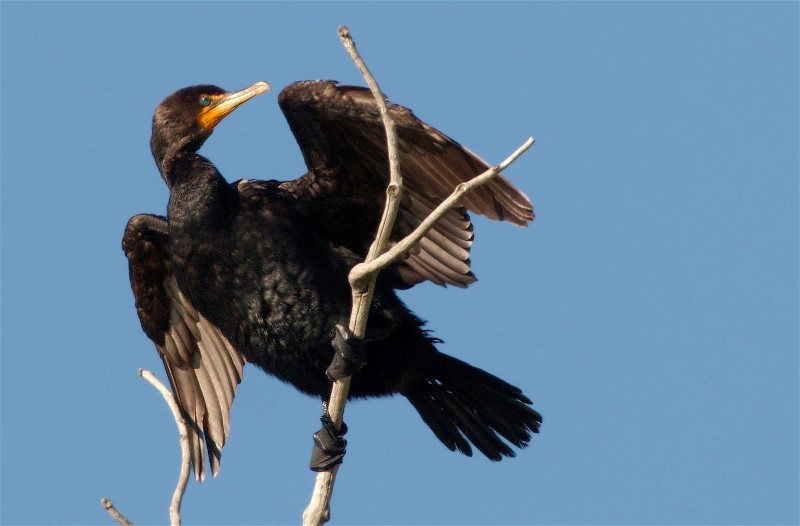
The third photo is that of a Snowy Owl and this is an extremely distant shot. I have made a major crop here for my finished image. There is a lot of atmosphere between us and the owl. When you are focusing manually it can be very hard to get an “in focus image” when your subject is a long ways away. One reason being, that it is difficult for our eyes to discern details at that distance. Picking out details, those differences in tone and apparent texture, is how you or your camera focuses. It is less obvious at a distance. I sometimes use an aperture with more dof at a long distance than up close, so to correct for any mistakes that I or my camera may make in focus. I made this image at f8. I hoped that if I missed my focus a tiny bit, f8 would carry enough dof to cover that mistake. If I was sure of my focus, I would have shot at f4 with this much distance. That would have killed any detail at all in those winter trees in the background, and made my image of the Snowy more simple and pure. As it is, it did keep the background detail just soft enough to be a usable picture. I should also add that the background showed some disturbing camera noise. In the editing process I removed some of that noise which did help to make that background less disturbing by softening it. Trying to gain detail in a bird while you attempt to keep detail at a minimum in the background, is a difficult but rewarding exercise.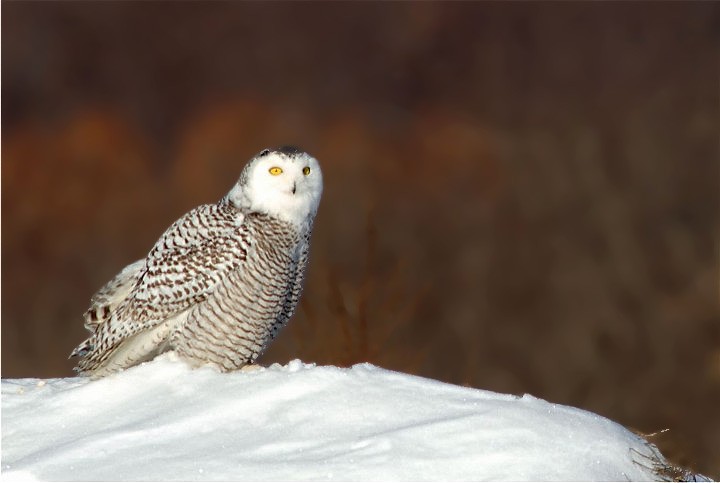
With wild animals we don’t always have the choices we would like. Our subjects do dictate some of the circumstances that we are faced with. Just the same when you are constantly exploring and exploiting every option, you will create a lot of satisfying images. Paying “attention to detail “, and controlling depth of field is a great place to start.
 Earth Images Blog by Wayne Nelson