I have not previously shared any of the below pictures.
When I am about to photograph historic architecture, the first decision I make is whether I want it to be black and white, or color. On most occasions I finalize that decision before I make the picture. I at least attempt to compose colors and tones (b&w) differently. When I am composing an image that is destined to be b&w, there is no need to play warm and cool colors off of each other. Which direction I go is pretty much instinctive because I spent so much of my photographic life switching back and forth between b&w and color films and prints. The need (in the old days) to carry both kinds of film, and decide which to put in my camera, made my decisions very deliberate. The one thing that will often push me towards a color rendition is the presence of a warm color that separates itself from the rest of the building or scene. It only needs to be a splash. Yellow, orange or red make the biggest difference
While the red roof on the residence to this Lake Superior light house barely showed, it was enough for me to think of my scene in terms of color and not b&w. You find that most of my images of not only historic architecture, but any architecture, are created as a matter of piecework. I love visually subdividing buildings into smaller sections. Sometimes it is nice to begin with an overview or a complete scene and then move on to piecework as I did below.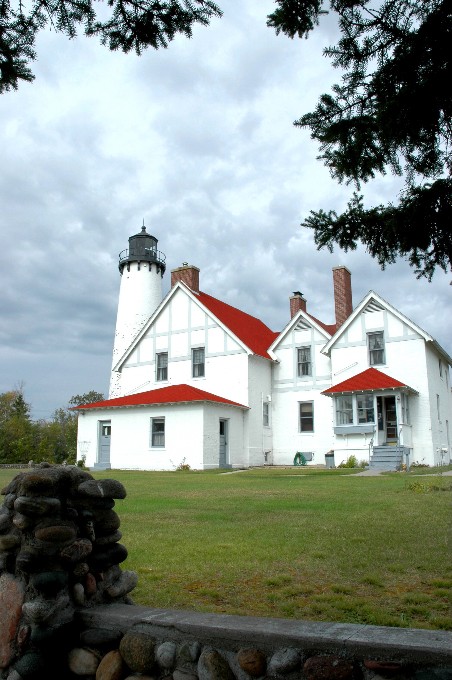

A splash of red from the roof, and a red roof vent was more than enough for me to know that this 19th century shop would be a color image. The added attraction of the warm red and the cool blue of the sky playing off of one another made it even better. To add a little more “color play” we have the blue lake and the slightly warm (cool but warmer than blue) green grass also stimulating us visually. While this is almost an entire building it is still very much a piecework image. That tends to show a more creative sense than just a photo of the whole building.
There was no doubt in my mind that color would be my choice for this 19th century barn, I have photographed this barn many times before and some of those images are b&w. In those shots, other nearby barns and outbuildings are a part of the scene. Those stone buildings impart a feeling of their antiquity much better in b&w. Only a small part of this barn showed in those scenes and the image was more effective in monotone. In this case I only showed the barn and it would have been a shame to have missed those red boards literally jumping out of the picture frame at the viewer. While there is a lot of barn and a lot red in this photo, this shot is still very much a piecework image.
When I photograph buildings or other manmade objects they are usually old. Having said that I will photograph anything that I find interesting. I rarely “read” modern scenes as b&w, therefore I compose the colors as I see them. I do photograph modern buildings in piecework fashion but more often it is not a single building that attracts me to modern subjects.
The image below was made in the predawn light of Lake Michigan with the Racine (Metropolis?) Wisconsin skyline in the background.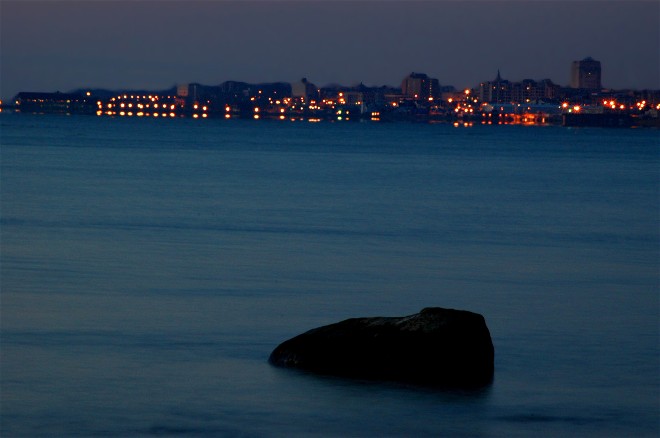
Humans do create a lot of interesting shapes and I am not above using manmade objects for a silhouette with Mother Nature’s light. This is a Lake Michigan viewing tower with an interesting top. My alternative was a straight view into the lake with no silhouette. I tried that view and decided to include the ”hand of man” in the scene
Let’s take a minute to talk about sunrise/sunsets. Many years ago I showed a photographer friend one of my slide books. It was a book of about 3,000 sunrise/sunsets. My nature files were still small back then but I had more of the aforementioned subject than anything else. He complimented me and then asked what kind of tricks I used to get so many images. Nobody could have that many shots of that subject and there are not that many colorful sunrises. A few years later I was giving a talk and showing some pictures at a camera club. I finished the show with some sunrises. I was immediately asked what kind of color filters I used. The point that was being made in both cases is that there just aren’t that many colorful sunrise/sunsets.
The reason I had so many images was just because I went out and shot them. The rest is pretty simple too.
When I go out to shoot a sunrise, I arrive well before the actual sunrise. With sunsets I stay well after the sun sets. Much of the best color is when the sun is below the horizon, and lights up the clouds from that position. I said clouds, but really you only need one cloud to make a colorful sunrise. You only need one break of the rising/setting sun to peak through a bunch of heavy clouds for 10 seconds and you may have a spectacular image. If you have a couple of zoom lenses, or several fixed focal length lenses, select a telephoto and you can pair down the amount of sky showing in the picture frame, to color and only color. Many, many of my sunrises show a limited view of the sky. They do tend to look like the sky is full of color. The more spectacular the whole sky becomes, the more I visually “back off” the scene by using short/wider lenses. Many of my sunrises lasted less than a minute. In fact I have sat on a gray morning waiting for something to happen and finally had one small opening with spectacular color. A 400mm lens, and 5 seconds of time, was all it took. When you think about it, sunrises and sunsets very much fit into the theme of reading your subject…a splash of color…piecework
If you are persistent, and you remain ready to shoot, and have a variety of focal lengths, you will fill your digital files with sunrise/sunsets more quickly that you can imagine. Keep your exposures a bit toward under exposure, unless you are looking for a light, ethereal quality to the finished shot.
Colorful and powerful sunrise/sunsets will be your easiest subject in nature. The possibilities are endless and the results are satisfying. Go out and enjoy.
 Earth Images Blog by Wayne Nelson