Filters: As I began to write today’s photo/text article, it occurred to me that I have never written about the use of filters in photography. I suppose the main reason for that is I used filters very sparingly in the later years of my image making, and since the advent of Photoshop/Lightroom etc. fewer photographers in general use filters. Just the same they are still in use by many and deserve a look.
During the 1990s filter manufacturers created many new enhancing filters. I never used one so I will not comment on those and limit this to the most used (and useful) filters.
When I began photography (1971) it was common to use either skylight or UV haze filters over every lens you owned. They had minimal color effect, there was no light loss and they protected your lens. I stopped this in approximately 1976. To me it was just another piece of unnecessary glass between the film and my subject. I did continue their use in dirt track auto racing photography through the 1990s because flying dirt and stones can cause havoc with the glass on your lens. I did use filters to correct daylight film for tungsten in studio photography, but that has no real importance for outdoor photographers. From that point on I only used three types of filters.
80B warming filter: Today with DSLR white balance settings, the warming filter is irrelevant. If you keep your white balance on auto it should automatically warm your scene on cloudy days, or when shooting in the shade. If you want warming for a special effect, simply set your wb to cloudy or shade.
Graduated neutral density filters: I used 2 stop, graduated (soft edge) filters. They are literally dark on one half and clear on the other. I used a very expensive Singh Ray ND, and a more cheaply priced Cokin Gray filter. Both work well but there is a slight pinkish cast with the Cokin. The idea of this filter is to place the part of the filter that is dark (2 stops less light) over the brighter part of a scene, and the lighter (no exposure value) part of the filter over the darker portion of the scene. It is designed to bring a contrasty scene together. I mostly used them when shooting directly at a sunrise/sunset. If wanted detail in the foreground it allowed me to put the dark part over the sun or lit clouds, and the lighter part of the filter over dark foreground. I would often stack two 2 stop filters. This would allow me to bring the sky and the foreground 4 stops closer together. Eventually I began accepting a dark silhouette style foreground for my first shots, then as the sun appeared and brightened the scene I would use the land, shimmering in early sunlight to give some detail to the foreground. It is all a matter of taste, but these filters are still relevant.
The Polarizer: I believe that this filter is the most important. It is also the most used and the most over-used filter. I think the latter is due to the fact that they are misunderstood.
There are three basic purposes for this filter. One is to darken a sky, or make it appear more blue. The second is to remove reflections from water and the surface of flowers, leaves, etc., and the last to intentionally lose (usually two) stops of light. In that case it used like a straight neutral density filter to blur moving water with longer exposures.
As light travels through our atmosphere it moves from left to right, and up and down in waves. That is called linear. It does not follow a straight path and there are some circular waves as well. The closer the light rays are to 90 degrees from the sun the more polarized they become, allowing a linear or circular polarizing filter to arrange those scattered rays in order. You are really un-polarizing the sky. The continuity derived from the filter provides the visual effect of a deep blue sky. A 90 degree angle to the sun itself is the best position by far, to accomplish that deep blue sky. A polarizer is an interactive filter. After you screw the filter on your lens, you can continue to turn the glass within the filter. Do this while you look through your viewfinder and you will actually see the sky darken. The same principals apply when you want to remove reflections from a surface. You will see those reflections disappear. People like to say that a polarizer will saturate colors. What it actually does is remove reflections from objects (flowers, etc.), which then allows that color to shine through and appear more saturated.
If a linear polarizer blocks or allows (depending on the position) up and down and left to right scattered rays of light, than a circular polarizer does exactly the same plus it blocks or allows the scattered circular rays which also travel through the atmosphere. A circular polarizer is actually made in two sections. One is a linear polarizer and the other blocks or allows circular light. All modern cameras need a circular polarizer in order to have your “in camera” metering system work. You can use a linear filter and use a separate hand held meter. Then you would open up your exposure by two stops. In other words you would slow your shutter speed down from say 1/500th to 1/125th or open your lens up from say f 11 to f 5.6, or use a combination of both.
What needs to be remembered is that with a polarizing filter on your lens you will merely have an extra piece of glass, or resin, that robs you of approximately two stops of light, unless you use it properly. You can become accustomed to seeing the changes in sky or reflections after turning the filter once or twice. If you choose to darken a sky but see no result no matter how you turn the filter, it is because you are not at the proper angle to the sun. Think 90 degrees. You must take care with wide angle polarized skies. There is a limit to how much sky can be evenly darkened. When you get below 50mm in your lens choice there can be a problem if your composition contains mostly sky. It has everything to do with how much sky is actually showing in the scene. A 20mm wide angled shot where there is only a sliver of sky in the composition, will show even polarization.
A polarizing filter is just as useful with digital photography as it was with film. Use it judiciously and never leave it on your lens when unnecessary, and I think you will find this to be a valuable tool.
The photos below are not related to the subject of filters.
All wildlife photographers spend a lot of time and effort to get close-up images of birds. When we fail, then we crop. Every once in a while it’s nice to back off and keep some visual space. A lot of times the same image with a little distance has a more artistic feeling to it than one that is tight.
I enjoy this American Kestrel picture “as is” without a close approach or a big crop. This image has not been shown before.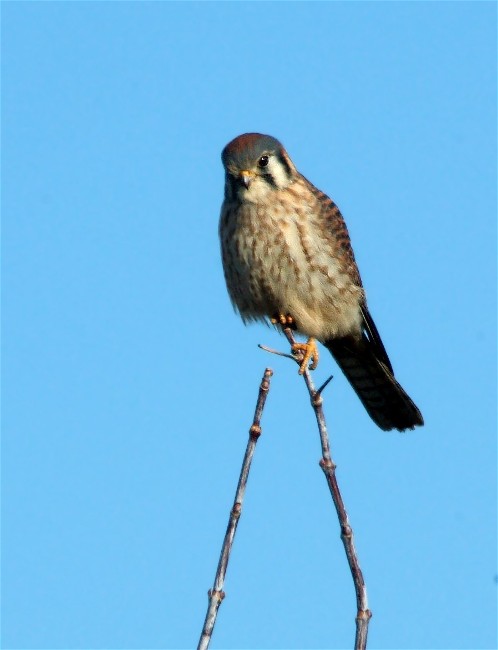
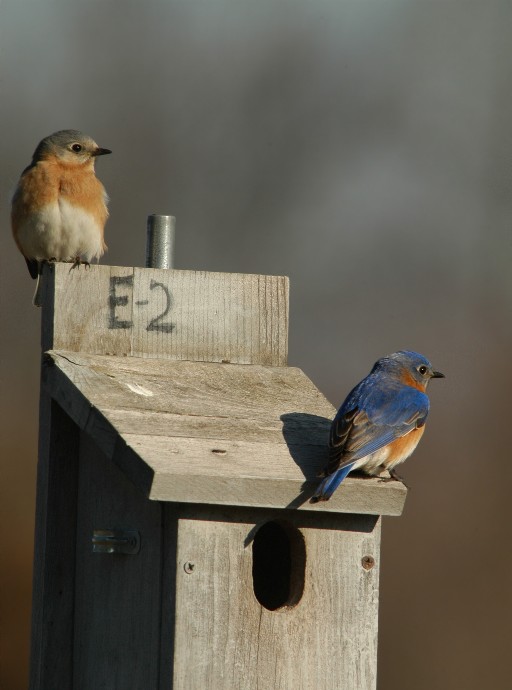
I had no choice but to stay back when I made this photo of a happy couple of Eastern Bluebirds. In fact I had to switch to a vertical format just to get them both birds in the picture frame. These images have not been shown before.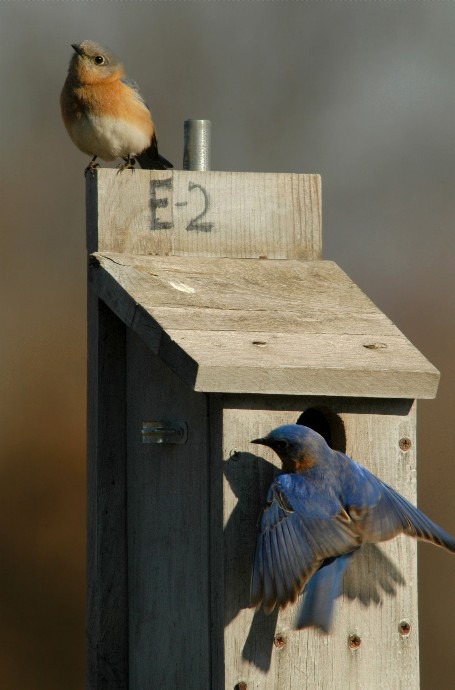
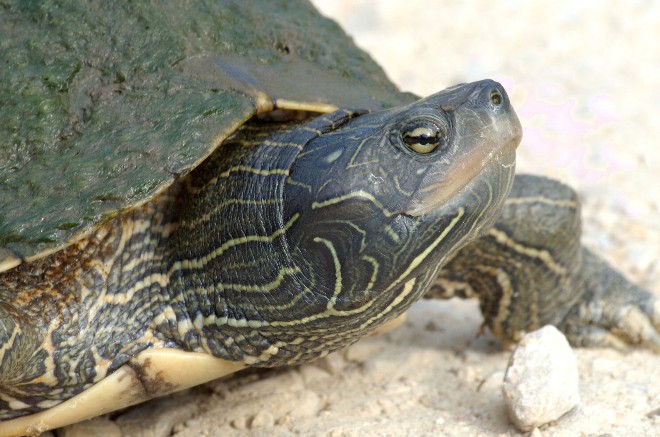
I love to wander and explore. Whether in the car or on foot, I rarely ever saw a dirt road or small trail that was not inviting me to wander. Those characteristics have been a blessing to me when I traveled along the Mississippi River. On a quiet morning I took yet another one of those “downhill” side roads that dead end along the river. There were a pair of Mississippi Red-bellied Sliders waiting as a greeting committee. The only thing I enjoy as much as wandering is photographing a new species of wildlife.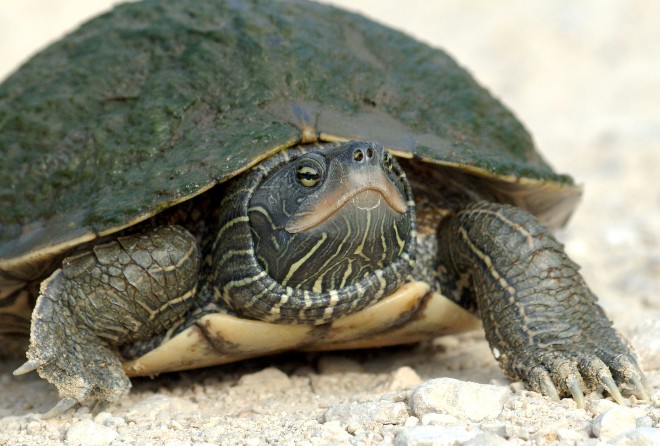
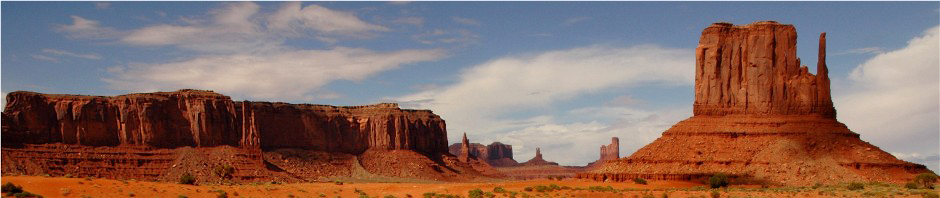
Canyonlands N.P. in Utah is in my opinion, one of this earth’s most beautiful (and powerful) locations. I visited CLs in the early 1990s and made only a few pictures using my Pentax 6×7 camera and Velvia transparency film. I have shown the image that I made seconds before this one many times. It has been published in book form and I think it might do a better job of showing what CLs is all about. Both pictures show off the light at dusk, and the drama of shadows. I do however love the fact that my composition in this photo also gives a powerful view of the LaSal Mountains. This mountain chain may well be the least known but most beautiful mountains in America. In addition to the golden colors bouncing off of the rock forms, the term “Purple Mountains Majesty” seems to have been written for the LaSal Mountains.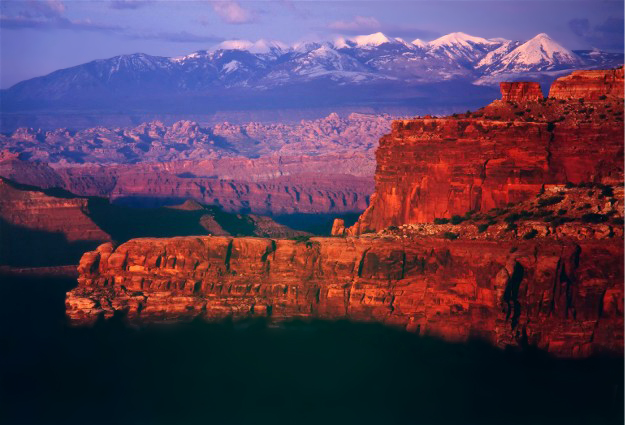
Does is seem to you that humor is a disappearing art form? I mean on websites, blogs, social media like Google Plus, Facebook, and Linkedon, life appears so unpleasant and serious. It was not that way at one time. In places like Twitter where people have always used humor, I judge by the replies that they either find that the humor misses the mark, or they simply don’t get it. I often feel my present life circumstances should suggest that there would be no attempt at humor that would appeal to me. I do still see the funny side of life. Humor is one of the few things that separates us from the animals. I know only too well that there is a lot of financial stress in the world today. Has anybody ever heard of the Great Depression? Some of this country’s greatest humor was born during that time frame. Maybe it is this enormous political and social divide that separates us from our neighbors, friends and relatives that leaves us with so little to laugh about. It seems to me that a good laugh should be the one thing that we can still share.
That’s my take on the current state of humor…….seriously
“A person without a sense of humor is like a wagon without springs. It’s jolted by every pebble on the road.” Henry Ward Beecher
“What the country needs is dirtier fingernails and cleaner minds.” Will Rogers
 Earth Images Blog by Wayne Nelson