I seldom make photography posts that only deal with two or three subjects. I’ve limited it today because the primary focus is about natural history. Today’s blog is about three birds, those being the American Bittern, the Tundra Swan and the Red-winged Blackbird. I will begin each subject with a biography taken from varied sites on the internet. I will then follow with a bit of what I have learned as a photographer about these birds. That info will be intertwined with some of my imagery.
No matter whether you look at your nature photography as documentary or art, (both?) I believe that subject knowledge is necessary. My own wildlife photography went up 1,000 notches when I began to truly study my subjects.
The American Bittern
Family:ARDEIDAE
Group Name:Herons, Bitterns, Egrets
Species Order:Ciconiiformes
Introduction: The American Bittern, a medium-sized heron inhabiting reed beds, is rarely seen because of its remarkable camouflage. However, it makes its presence known with its booming song, which can be heard long distances away, particularly at dawn or dusk in the spring.
Fun Fact: Because the American Bittern can create a resonant tone with little movement of its bill, it is also known as the “stake-driver,” “thunder-pumper,” and “mire-drum.”
Habitat: Freshwater and saltwater wetlands.
Weight: 1-2 pounds.
Length: 28 inches.
Wingspan: 42 inches.
Life Expectancy: Approximately 8 years of age.
Food:Frogs, salamanders, crayfish, water scorpions, diving beetles, dragonflies, killifish, pickerel, suckers, small eels, garter and water snakes, and occasionally voles.
Status: Endangered.
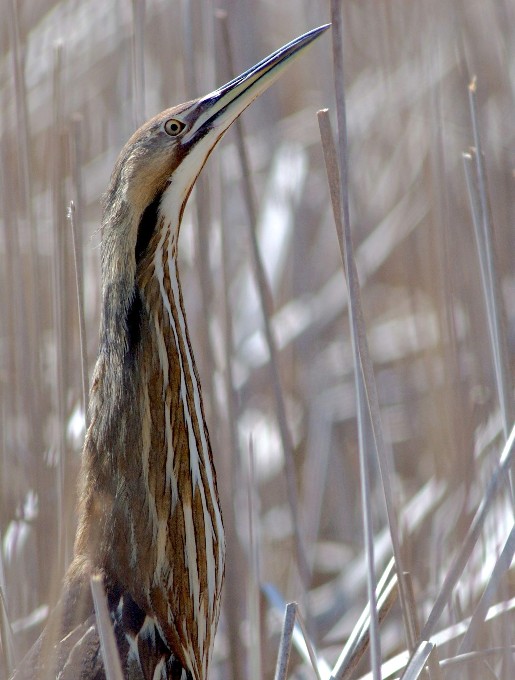
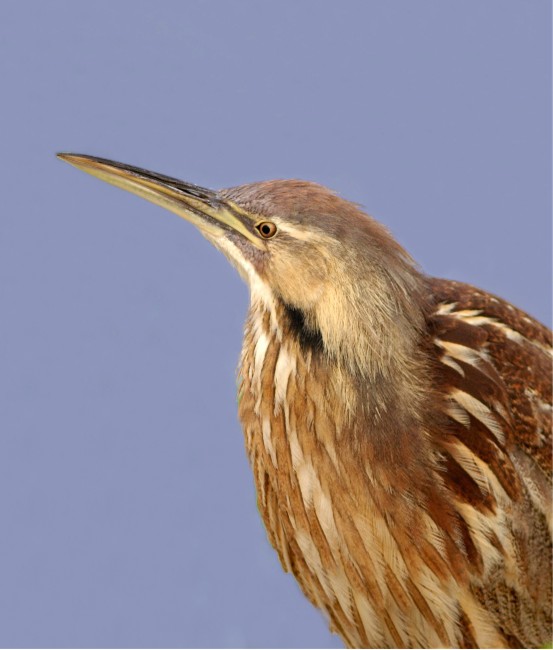
Identification: Adult American Bitterns are large, somewhat stocky birds with yellow eyes, rich brown upper parts, and a white throat that is offset by black streaks. Dark flight feathers are conspicuous on the wing tips when the birds are in flight. The sexes are similar in appearance. Juvenile bitterns lack neck streaking.
Range: American Bitterns occur from Central British Columbia east to Newfoundland, south, locally, to the Gulf Coast and west to southern California. They migrate south, but not to the extent that many other wetland birds do. The species winters in the southeastern and Gulf States and as far south as Central America and Cuba.
Reproduction: American Bitterns migrate north to breed from mid-April to early May. Unlike other members of the heron family, these birds are not colonial nesters. Male bitterns may be polygamous (more than 1 mate) and often have several females nesting separately within their territory. Females choose the nest site in wetland areas, usually on the ground or raised slightly on a platform of thick vegetation. The female also builds the nest, usually out of reeds, sedges and similar plant material. The nest is 6 to 13 inches high and 12 to 16 inches wide, The 2 to 5 elliptical, olive-buff to buff-brown, slightly glossy eggs are laid at daily intervals.
Incubation begins when the first egg is laid and lasts for 24 to 29 days. The female is responsible for both incubation and tending the young. Young bitterns differ in size. They leave the nest after about two weeks but continue to be tended nearby. Their age of independence and first flight is unknown.
Reason for Decline: The primary reason for the decline in American bittern populations is loss of habitat. The marshes and swamps upon which this species depends have been drained and filled for a variety of human uses including roadways, housing and commercial developments.
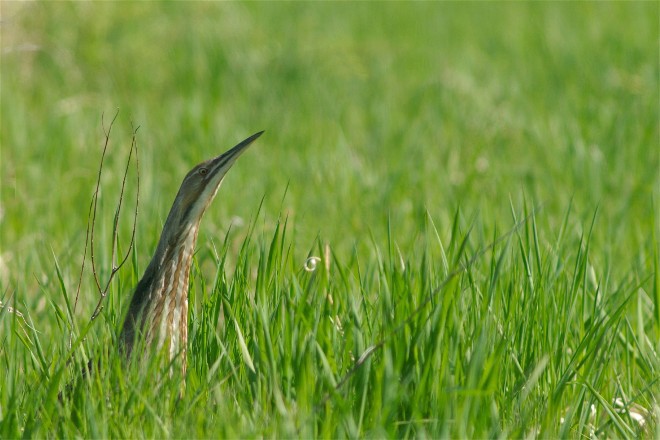
Interesting Facts: The American bittern, like many other herons, is solitary and moves slowly and secretively through dense marsh vegetation. Bitterns are most active at dusk and through the night. If alarmed, a bittern will stand motionless with its bill pointed straight up and its body contracted. This habit gave the bird its regional names of sky-gazer, look-up and stake-bird. Bitterns that flush when startled give a nasal “haink” call and beat their wings rapidly as they take flight.
Bitterns call most often in the spring. A loud, guttural “pump-er-wink” is usually heard at dusk and gets its booming quality from a specialized esophagus. This unique call has led to many other common names, including water-belcher, mire drum and thunder pumper.
During the breeding season, the males perform a remarkable courtship walk displaying white fan-like ruffs raised over their back and shoulders.
Protective Legislation: Federal – Migratory Bird Treaty Act of 1918.
What You Can Do: Support for strong wetland conservation legislation, along with water pollution control efforts, will help protect the habitat of American Bitterns.
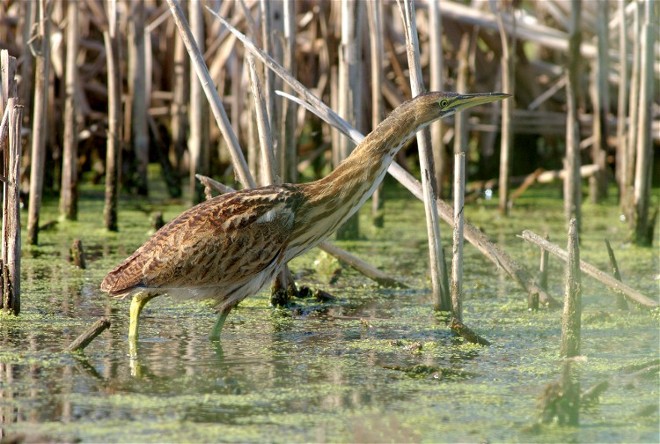
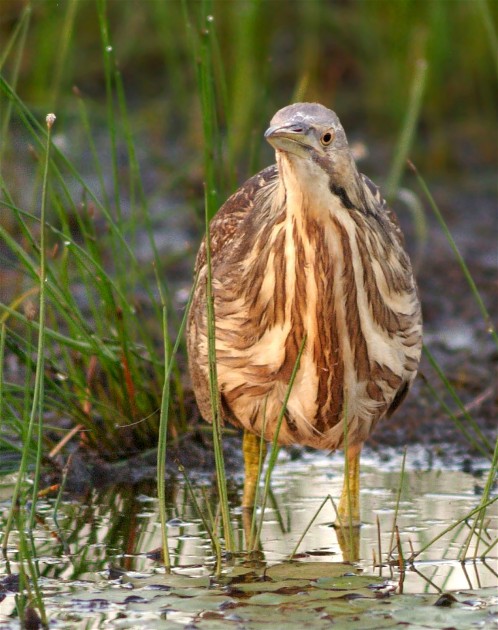
The American Bittern is not the easiest member the heron/egret family to photograph. I know many wildlife photographers who have never made a showable picture of these guys. I know others who have never seen one although most heave heard them. They are masters of camouflage, and are vert patient. They can remain motionless in tall grasses or among the cattails of a marsh for a very long time. I live in Wisconsin which is in the north central portion of the U.S. and I have been fortunate to succeed six times in photographing these birds. Five times Horicon Marsh NWR has provided me with images and once in Sandhill State Wildlife Area. I have seen them on one other occasion at Horicon and once in Crex Meadows and once at a Great-blue Heron rookery in Illinois. It takes a very slowwww drive or walk through a good marsh (like Horicon) or an adjacent grassland. They are there. When you find them if you are quiet, you usually have a good amount of time to make your pictures. They need to believe you do not see them so only stare at them through the lens of your camera or binoculars.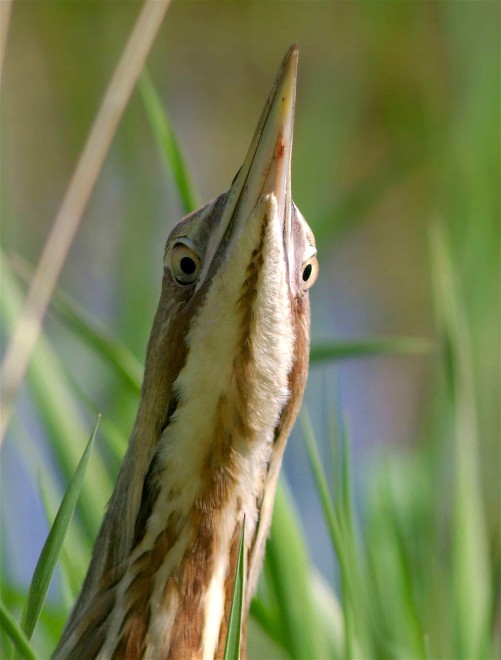
Tundra Swan
Cygnus columbianus ORDER: ANSERIFORMES FAMILY: ANATIDAE
True to its name, the Tundra Swan breeds on the high tundra across the top of North America. It winters in large flocks along both coasts, and is frequently encountered during its migration across the continent.
Cool Facts: The whistling swan, the American race of the Tundra Swan, currently is considered the same species as the Eurasian race, the Bewick’s swan. They were considered separate species in the past, distinguished by the large yellow patches on the face of the Bewick’s swan.
During the breeding season the Tundra Swan sleeps almost entirely on land, but in the winter it sleeps more often on water.
Swan nests on the tundra are vulnerable to a host of predators, such as foxes, weasels, jaegers, and gulls. If the parents are present, they are able to defend the nest and nestlings from these threats. Wolves, people, and bears, however, are too big to fight, and most incubating swans leave their nests while these large predators are far away. By leaving quickly when large predators approach, the parents may make the nest harder to find.
The Tundra Swan stays in flocks except when on a breeding territory. Although most swans spread out to breed, a large proportion of the population on the breeding grounds still can be found in flocks. These swans are not breeding, and may be young birds that have not yet bred, adult pairs whose breeding attempts failed, or adults that bred in the past but for some reason do not in that year.
Habitat: Lake/Pond
Breeds on tundra lakes, ponds, and pools along coast. Winters in shallow estuaries, lakes, ponds, and rivers; feeds in agricultural fields.
Food: Plants
Aquatic plants, seeds, tubers, grains, some mollusks and arthropods.
Nesting: Nesting Facts
Clutch Size: 3–5 eggs
Egg Description: Creamy white.
Condition at Hatching: Covered with down and eyes open. Leaves nest within 24 hours of hatching and has the ability to swim and feed.
Nest Description: Nest a large open bowl, made of grasses, sedges, lichens, and moss, lined with only a little down. Usually placed on mound or ridge in tundra.
Conservation: Common and may be increasing. As a game species, populations managed by U.S. Fish and Wildlife Service and Canadian Wildlife Service.
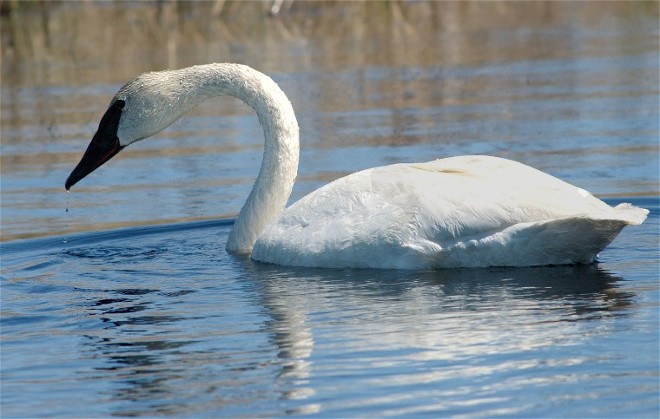
There are three species of swans in North America and we are fortunate to have all in WI. The Tundra is a migratory visitor in spring and fall while the Trumpeter and Mute can be found all year depending on the availability of open water.
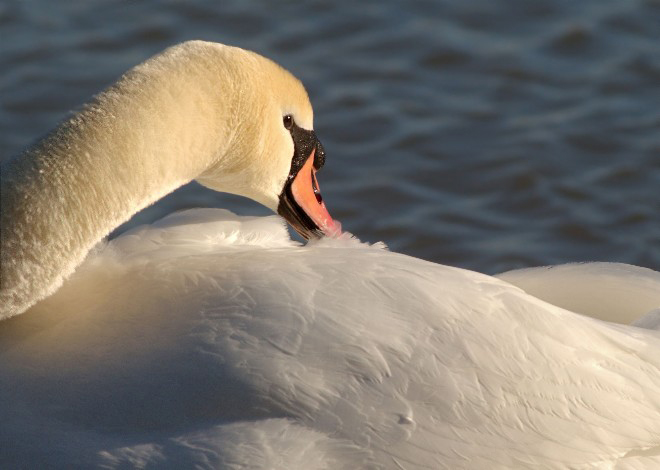
The Tundra can be found in large numbers (during migration) at Goose Pond and other ponds in Columbia County, Reick’s Lake near the Mississippi River and Horicon Marsh. Trumpeters are a re-introduced species and are usually in family groups in fairly remote locations, and Mutes were brought here from Europe and often occupy city parks and cemeteries.
Large flocks (Tundra’s) mean that one bird can send everyone flying and for that reason I find the Tundra to be the most difficult of the three to photograph. City Mutes are very easy, although I find remote and wild birds to be a somewhat difficult subject. Trumpeters are almost friendly, which has often been their downfall.
The one wild animal who has actually physically attacked me, is the Mute Swan. All swans will defend their nests and their young. I got a bit too close to the female and her goslings and papa charged and hit me. I am glad that swans don’t have teeth. Of course I left the scene immediately in order to reduce their stress.
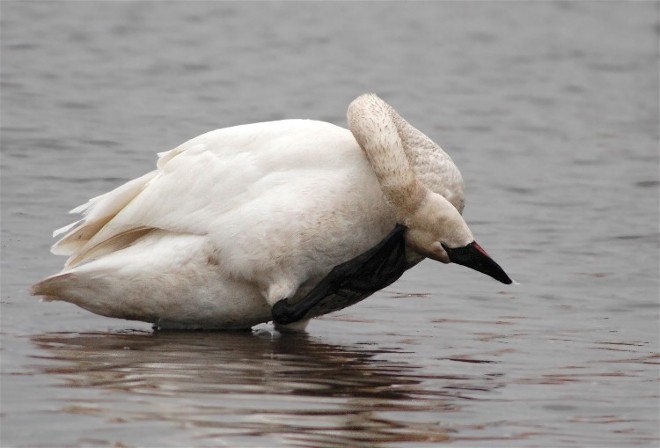
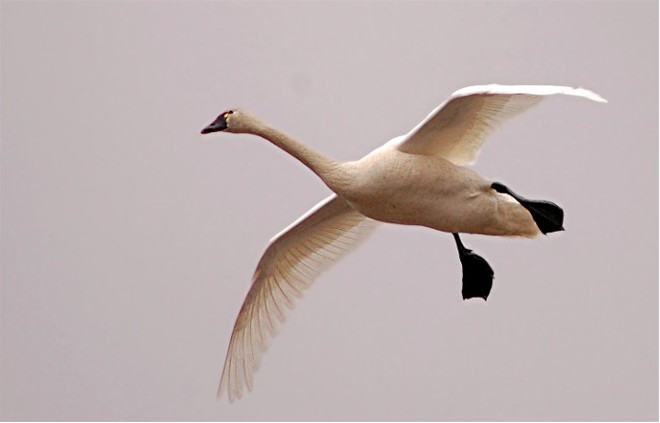
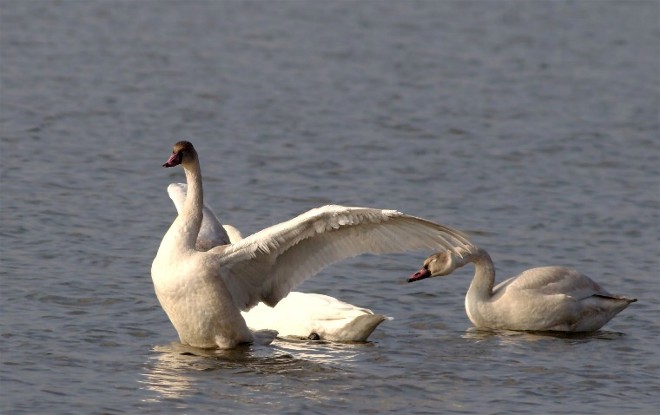
Tundra’s are the smallest of our three swans with Trumpeters being noticeably larger and Mutes even bigger. Mature Tundra swans often have an identifiable yellow mark in front of their eyes. You will notice it on my first picture of a mature Tundra with its immature offspring. Mutes have the large forehead bump that easily sets them apart. Trumpeters and Mutes are in my opinion the most artful of the three as they bend their necks into graceful S curves. All will often get stained heads from browsing on water plants along the bottom of shallow ponds.
Tundra Swans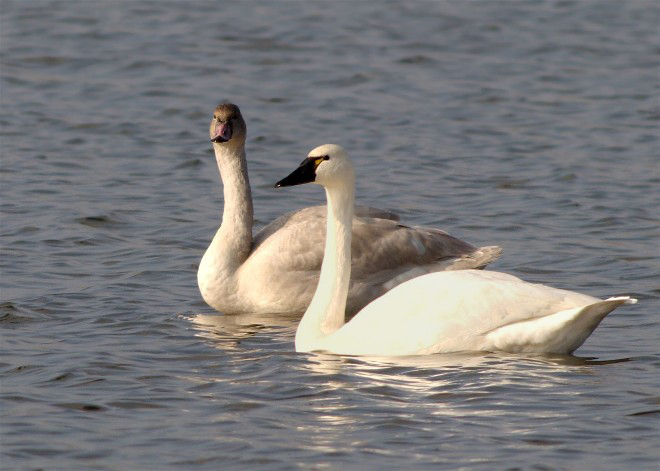
Trumpeter Swans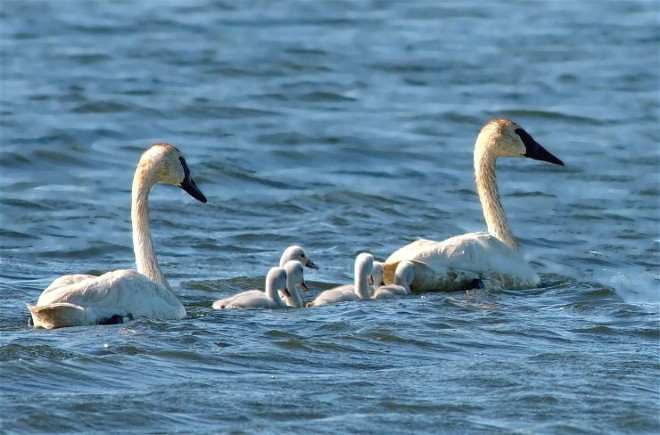
Mute Swans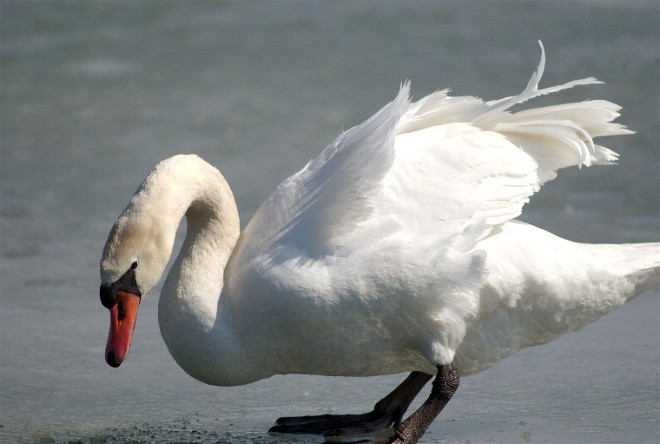
Red-winged Blackbirds
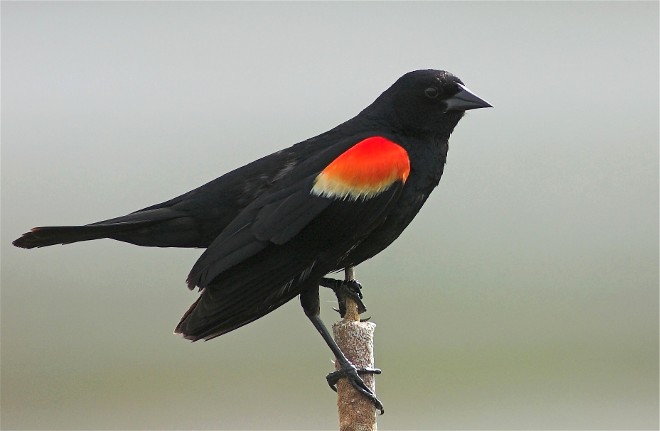
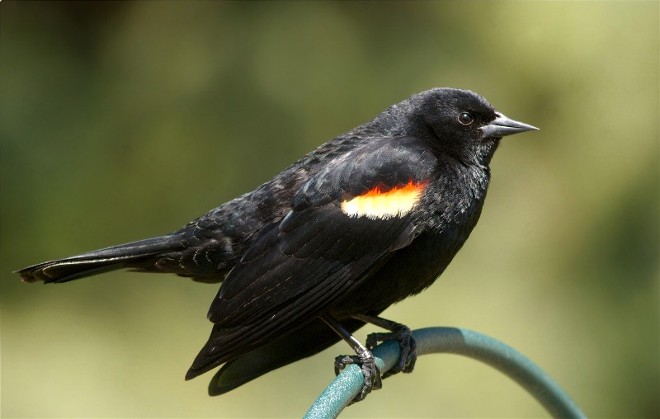
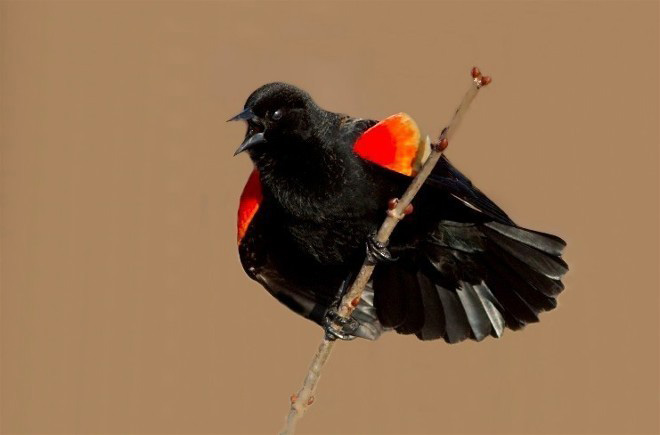
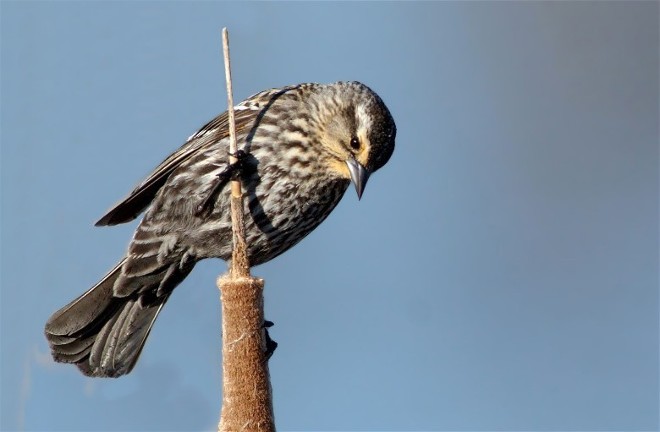
Our final bird is one of North America’s most common, the Red-winged Blackbird. The male RWBB is also one of North America’s most photographed birds. There is good reason for that. Not only do they put on a nice display with their vocalizations but they flash those red shoulder patches. They also tend to perch in wonderful places where clean and beautiful backgrounds are possible. This is because they want to be seen and noticed by other male RWBBs. They often will sit for pictures, because they are one of nature’s most fearless creatures. I have seen them physically attack hawks, eagles and owls. I have made pictures of a male RWBBs attached to the back of a Sandhill Crane. The female shows this species to be a practitioner of the art of sexual dimorphism. The two sexes are very different. While the female is seen less often as she tends to stay at the nest, when you do find them they too usually perch in wonderful places for those clean and pretty pix.
Measurements: Both Sexes
Length
6.7–9.1 in
17–23 cm
Wingspan
12.2–15.7 in
31–40 cm
Weight
1.1–2.7 oz
32–77 g
Relative Size
About three-quarters the size of a Common Grackle
Other Names
Carouge à épaulettes (French)
Tordo alirrojo, Tordo capitán, Mayito de la ciénaga, Sargento (Spanish)
Cool Facts: Different populations and subspecies of Red-winged Blackbirds vary markedly in size and proportions. An experiment was conducted that moved nestlings between populations and found that the chicks grew up to resemble their foster parents. This study indicated that much of the difference seen between populations is the result of different environments rather than different genetic makeups.
The Red-winged Blackbird is a highly polygynous species, meaning males have many female mates – up to 15 in some cases. In some populations 90 percent of territorial males have more than one female nesting on their territories. But all is not as it seems: one-quarter to one-half of nestlings turn out to have been sired by someone other than the territorial male.
Male Red-winged Blackbirds fiercely defend their territories during the breeding season, spending more than a quarter of daylight hours in territory defense. He chases other males out of the territory and attacks nest predators, sometimes going after much larger animals, including horses and people.
Red-winged Blackbirds roost in flocks in all months of the year. In summer small numbers roost in the wetlands where the birds breed. Winter flocks can be congregations of several million birds, including other blackbird species and starlings. Each morning the roosts spread out, traveling as far as 50 miles to feed, then re-forming at night.
One California subspecies of the Red-winged Blackbird lacks the yellow borders to the red shoulders (epaulets) and has been dubbed the “bicolored blackbird.” Some scientists think this plumage difference may help Red-winged Blackbirds recognize each other where their range overlaps with the similar Tricolored Blackbird.
The oldest recorded Red-winged Blackbird was 15 years 9 months old.
Habitat: Marsh
Red-winged Blackbirds spend the breeding season in wet places like fresh or saltwater marshes and rice paddies. You may also find them breeding in drier places like sedge meadows, alfalfa fields, and fallow fields. Occasionally, Red-winged Blackbirds nest in wooded areas along waterways. In fall and winter, they congregate in agricultural fields, feedlots, pastures, and grassland.
Food: Insects
Red-winged Blackbirds eat mainly insects in the summer and seeds, including corn and wheat, in the winter. Sometimes they feed by probing at the bases of aquatic plants with their slender bills, prying them open to get at insects hidden inside. In fall and winter they eat weedy seeds such as ragweed and cocklebur as well as native sunflowers and waste grains.
Nesting: Nesting Facts
Clutch Size: 2–4 eggs
Number of Broods: 1-2 broods
Egg Length: 0.9–1.1 in 2.2–2.7 cm
Egg Width: 0.6–0.7 in 1.6–1.9 cm
Incubation Period: 11–13 days
Nestling Period: 11–14 days
Egg Description: Pale blue-green to gray with black or brown markings.
Condition at Hatching: Blind, naked with scant buffy or grayish down, poorly coordinated.
Nest Description: Females build the nests by winding stringy plant material around several close, upright stems and weaving in a platform of coarse, wet vegetation. Around and over this she adds more wet leaves and decayed wood, plastering the inside with mud to make a cup. Finally, she lines the cup with fine, dry grasses. One nest picked apart by a naturalist in the 1930s had been made by weaving together 34 strips of willow bark and 142 cattail leaves, some 2 feet long. When finished the nest is 4 to 7 inches across and 3 to 7 inches deep.
Nest Placement: Shrub. Red-winged Blackbirds build their nests low among vertical shoots of marsh vegetation, shrubs, or trees. Females choose the nest site with some input from the male. Typically, she puts the nest near the ground (or water surface in a marsh), in dense, grass-like vegetation such as cattails, bulrushes, sedges, and Phragmites in wetlands; goldenrod, blackberry, or willow and alder trees in uplands; and wheat, barley, alfalfa, and rice plants.
Behavior: Ground Forager
Male Red-winged Blackbirds spend much of the breeding season sitting on a high perch over their territories and singing their hearts out. Females tend to slink through reeds and grasses collecting food or nest material. Both males and females defend nests from intruders and predators. Red-winged Blackbirds nest in loose groups in part because appropriate marshy habitat is scarce. Typically five or more (up to 15) females have to crowd their nests into any one male’s territory. They typically mate with the territory holder, though many also mate with nearby males. In fall and winter, Red-winged Blackbirds flock with other blackbirds, grackles, cowbirds, and starlings, feeding on open ground and roosting in flocks of thousands or millions of birds. Red-winged Blackbirds are strong, agile fliers.
Conservation: Least Concern
Perhaps the most abundant native bird in North America, with an estimated population of 190 million individuals in 1974. Populations increased greatly in the middle of the 20th century
Males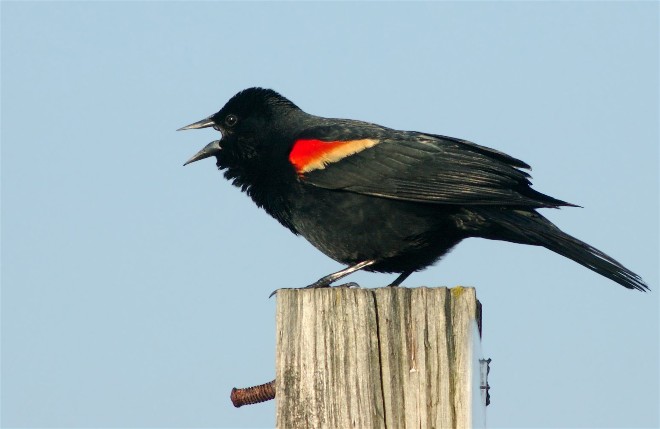
Females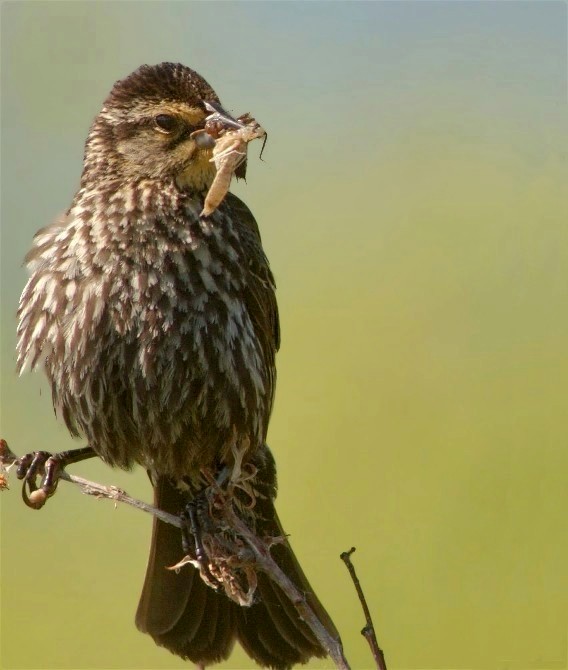
The great thing about nature photography is we have an infinite number of subjects. We can also choose to make pictures that educate, or inspire. I always enjoyed making informative images that helped tell the story of nature. I also loved making those inspirational photos that left something to the imagination.
Subjects…..style. It’s all up to you.
 Earth Images Blog by Wayne Nelson