In my last post I showed a photo that I had just taken of a female Bufflehead Duck. The photo below shows just how striking sexual dimorphism is in ducks, especially Buffleheads. This older shot of a male displays green and purple, along with the seemingly black head of this bird. Other photos show various degrees of red, yellow and blue.
One “duck like” bird where the sexes show no differences, are grebes. These two very different appearing Horned Grebes are at different periods in their seasonal change of feathers. The first bird is about 90% into its summer breeding colors and the second one is barely showing any change. This image was made in April, which might suggest that the second bird is younger and just beginning its first summer plumage.
As a stock photographer I always looked for images that had either/or, two birds in different age or seasonal plumages, both sexes in one photo, or a shot with multiple species. It is challenging and a lot of fun to see if you can find the correct combination for photo editors.
When you are marketing stock landscape images you will find that pretty, seasonal pictures sell well. You will also find that editors need pictures of specific locations. I discovered that they are also often in need of a “type” of photo, regardless of the location. In other words snow-capped mountains might be desired, but they could be from Colorado, or Montana, or maybe Canada. Maybe even the Alps. In the early 1990s I realized that one such type of shot I was missing in my files was that of the southern U.S. Cypress Swamp. Or lake or river. I remedied that in two back to back years. One of the things I did not like about the images of this type that I was seeing in the market was most of them were a jumbled mess. Confusing to the eye. In many cases they were deep forests on sunny days, and the light contrasts were hideous. I solved the problem first with a misty morning at Reelfoot Lake Tennessee. The lake at this fascinating state park was created by an earthquake many years ago. I found the east end of the lake to provide some very nice trees in a fairly open area.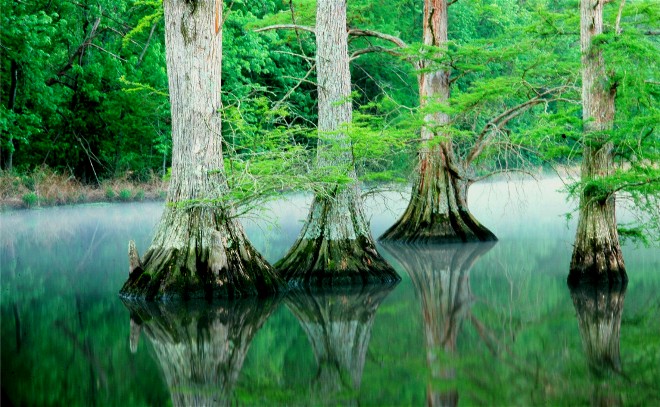
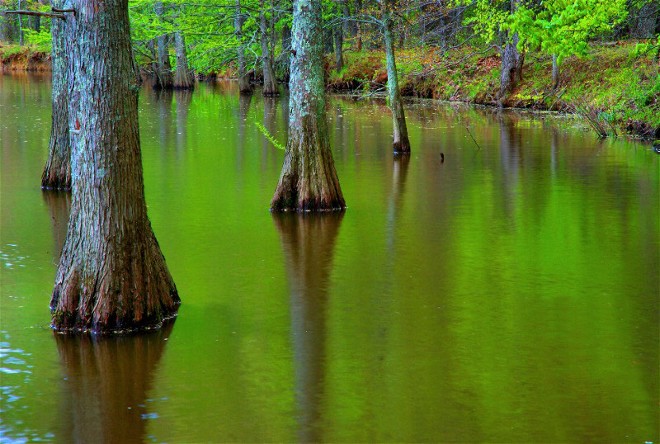
My second trip took me to the Mingo River south of St. Louis. Once again I found it possible to create enough separation between the Cypress Trees and other foliage, to make an image that said what I wanted it to say. When you are here in spring, the sun will filter through the new greenery and reflect into the river, creating a lively and fresh appearance. The second Mingo image shows that. That picture is a digital original from recent years but is not an HDR image, and has not been saturated. I actually brought my lunch to this spot so I could absorb the atmosphere for a longer period of time.
I love creating sunrises and sunsets. In fact I love being out at that (especially sunrise) time of day. The sr/ss image files that I (and you) have built over the years are shockingly different. The image below was a sunrise made at Bong State Rec. Area, here in Wisconsin. There are some differences in this shot and the more traditional images. Normally we either point the camera towards the sunrise, and record those beautiful colors, and maybe reflections. We silhouette any shapes in the foreground. This does make a beautiful image. When we have objects like mountains, rock forms, autumn trees and others in the opposite direction of the sun, we photograph those objects basking in the warm glow of the rising or setting sun. These are also beautiful. Every once in a while you can find the sun, just barely breaking the horizon, and illuminating some spectacular clouds in the opposite direction. When everything is just right, on an occasion, the prairie, wetland, forest or whatever exists near ground level will hold just the tiniest bit of detail. Such was this morning. The dilemma I faced was that if I exposed to keep those clouds deep and rich in color, my camera would not record that subtle detail in the wetland, prairie and trees that my eyes saw. The answer was in my camera bag in the form of a soft edge two stop graduated neutral density filter. Placing the area where the dark and light parts of this filter meet right at the top of the trees, I was able to hold back the lighted clouds by two stops of light and allow some detail to show through in the foreground. I could have stacked two filters and created a foreground that showed even more, but in my opinion that would have ruined the atmosphere of this morning.
For those who create a lot of sunrises/ sunsets, I would suggest one of these filters. There are also hard edge graduated filters for sharp edges where lake meets sky etc,. but if you only get one filter, that soft edge makes it very easy to blend two parts of a scene.
One of the things photographers attempt to do when making wildlife images is, keep your subjects at eye level with the viewer. This gives us a human connection. It is how we normally communicate with most people. Eye to eye. Sometimes wild animals, especially birds, can make this difficult. Most birds fly and they often perch high above our heads. When we can’t get up to eye level there are a couple of techniques that can help. The longer a lens is, the more it flattens out the perspective. Also if you back up from a high perch, you also lower your subject. A bird on a high perch could be brought to eye level if we could just back up 1,000 feet, and use a 2,000mm lens. Of course we can’t do that but we can use the longest lens we own, back up a bit and then crop the picture when we get home. I have worked with other photographers who thought I was crazy when I added my 1.4 converter to my 500mm lens when we moved closer to a cavity nest in a tree. Their logic was that I should shorten my lens as we got closer, and lengthen it as we moved away. In this case their thoughts were backwards. I did that because as we got closer the angle to the bird became steep. Adding some length to my lens reversed a little bit of that.
The two Bald eagle pictures below were taken about an hour apart, on two perches that were maybe 50 feet from one another. Those perches were at approximately the same height. I used the same 500mm lens without any extension for both photos. Both pictures are crops with the top shot being a moderate crop and the bottom image just a tiny crop. Those facts will tell you that I was further from the eagle in the top picture. My greater distance made sure that we would seem to be closer to the altitude of the bird in that picture. The closer shooting distance from the bird in the second photo is why we are forced to look upwards. You can see this is a little more awkward. From time to time I would intentionally make images at this angle, in order to more faithfully display a perching location that was up high, but in general an image is more relatable and comfortable when we appear to be at the same level.

I have always attempted to make the pictures that other photographers pass on. I also make the same types of pictures. I just wanted the angles and stories that most photographers ignore. There has definitely been some rewards to this approach. About five years ago I actually had an art director contact me to ask if I had any pictures of birds from the back. Boy was I ready for that one.
Rain dance, or snow dance? Snowy Owl.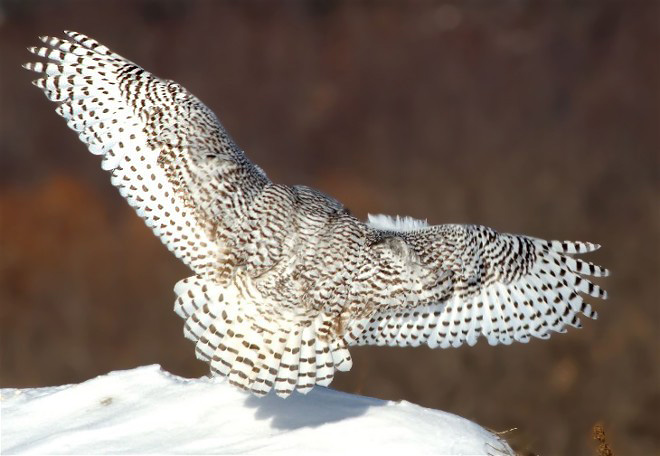
I want to wish each of you a happy and safe New Years. I am appreciative and amazed that after all of these years anyone will stop by just to see my photos and read my thoughts. I am humbled and very grateful.
 Earth Images Blog by Wayne Nelson