As the title suggests, today’s post is about pictures and the thought process we use to create them.
I truly love photographing waterfowl. Among the many varied species that we find in the water, grebes and mergansers are favorites of mine.
As I arrived at this Lake Michigan harbor I spotted several Red-Breasted Mergansers. I noticed the afternoon light was reflecting from a near-by building and was creating rust colored highlights along the surface of the water. As I shot pictures in the middle of harbor, I kept my eye on the area near the building. After about thirty minutes one bird finally made its way to my preferred location. I enjoy those little reflections just as much as I do the bird.
A few posts back I showed a series of images of Short-eared Owls. They were made with that “clean and simple” concept that always makes for a successful picture. Those three blue sky images were all made the same day and the picture below was made at the same location, the very next day. As I drove up and spotted the owl on the small rise among the winter foliage, I remember being happy. Something different from yesterday. Busier habitat shots can often be ordered, and give the viewer some info on the life of the subject as well. With the bird’s face unobstructed and an interesting sidelight, this photo is pretty strong. What is missing in this light and composition, is a lot of specific detail in the bird. The overall image makes up for that.
Back to the traditional clean and simple. The thought process here was pretty easy. You’ve got a male Eastern Meadowlark singing on a plant. This image was made from a car and I started and moved that car twice to find an angle that would provide a clear background. The bird flew away once and returned during that time.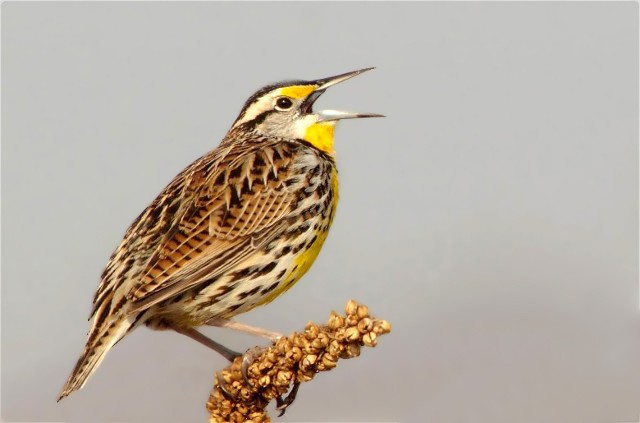
I found this Bonaparte’s Gull on a Racine, Wisconsin, Lake Michigan beach along with about 200 squawking and courting Caspian Terns. There was no way this quiet little gull was going to tolerate this forever. I made some portraits but my mind was anticipating the second shot below. Understanding wildlife and arriving at an educated guess as to their likely behavior will often bring to you the very picture that is racing through your mind. Always keep those wheels in your head turning.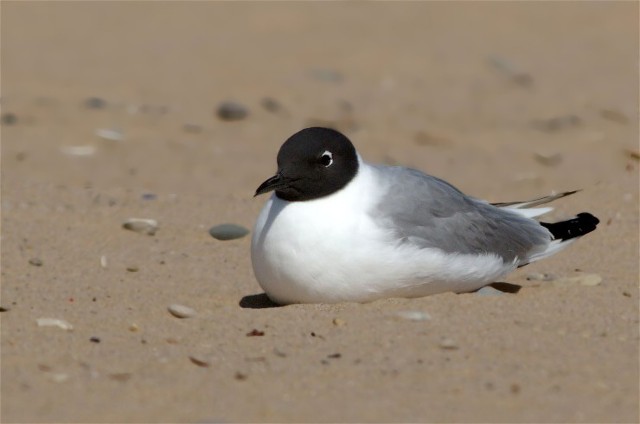

Snapshots.
When is it okay to take snapshots? I make a point of always writing “I do not take snapshots” I do however believe that with wildlife, when in doubt make the picture. You may never get another chance. I made about eight pictures of the Mt. Goat and three of the River Otter. That may disqualify these shots as snapshots, but I had very little time, and I took what I could get.
I was finally reaching the peak of Mt. Evans in Colorado when I spotted a small group of Mt. Goats. There was no way I was going to get any shots from the car. While I searched along the narrow road for somewhere to park, the goats began to get farther away. I parked the car, grabbed the camera with my 70-300mm zoom, a tripod, and headed for the goats. They were not afraid of me but just the same they were headed down the other side of the mountain. I shot as fast as I could and managed eight pictures. My ninth picture would have required climbing down the other side of this rock with a drop that would have require either the same skill set as the Mt. Goats, or wings. I settled for the only pix I have ever made of this species. I could have set up a better picture but the goats would have been long gone by that time.
I have photographed River Otters before but it had been 20 years since my last good picture. I had just about ( I estimate) 6 seconds to get out of my car with my camera and 500mm lens, rest that combination and squeeze off 3 shots before the otter disappeared into the marsh. Sometimes you just have to go for it and hope you did good. I only do this when I feel I have no other choice.
When I first saw this white ice and black water I knew I had something different. The water appears as it does because of the black rock below the surface. This was an original 35mm slide. Exposure was my concern. A multi segmented reading might balance the white and black but I decided to meter the old-fashioned way. I used manual metering and pointed the camera at a neutral gray rock. That would keep the ice white and the black a dark gray. I set my camera for 2/3rds of a stop under exposure. My hopes were that the water would go black, but the under exposure to the snow, would not turn it gray. It worked.
There’s not a whole lot of complex thinking to this shot of the aptly name Turquoise Lake, high in the Colorado Rockies. I did not even trick the white balance, or use filters to counteract the UV light at this altitude. The color here, while it may seem unusual is right on to what was seen with the naked eye. So sometimes the thought process is weak, and it still works. Of course making the decision to settle for a simple composition and use the color “as is”, is in fact, the thought process behind the picture.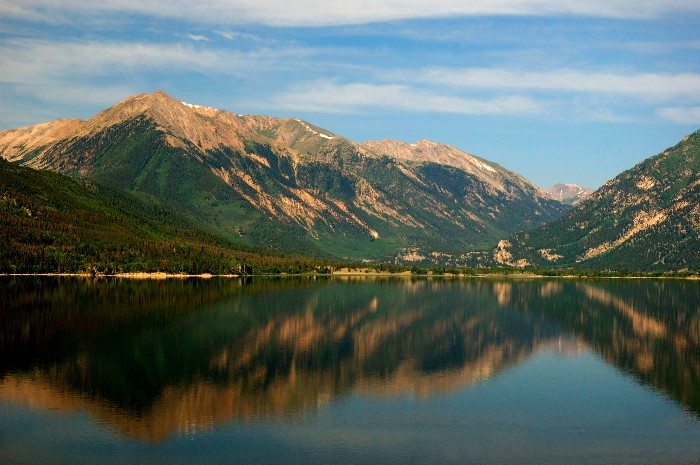
I want to thank you for stopping by at Earth Images
 Earth Images Blog by Wayne Nelson
Thanks for today’s post. I love the sand pouring off the feet of the gull. Sometimes little details can make a huge impact.
Cindy
Thanks Cindy. That sand is definately what sets that shot apart. I wish I could say that I planned it that way, but………
Wayne