The most viewed post on this blog has been Composition 101….All About Rules http://wp.me/pXX8j-1aa We dealt with the most common rules in that post. The rule of thirds, power points, leading lines and the unnamed rule that suggests (strongly) that when making wildlife pictures you should leave some open or negative space in the direction an animal is looking. These are all good rules but there are other compositional tools that can be used.
Frames are one way to highlight the central subject in a photo. Not those wooden and metal frames that we surround our picture with after the fact, but natural frames that are included within the original image. I love rock forms and have traveled through much of the American west in search of them. We only have a few “rock spots” in Wisconsin. I was teaching a workshop in Wisconsin’s Door county and naturally we had to stop when I spotted this bit of rock that had penetrated the surface of a near-by hillside. It seemed a good choice for framing. This image is satisfactory but surely not a favorite of mine. The rock and blue sky are framed to the point of “almost” being encircled by foliage. I would have prefered to have found some more branches to complete the circle. Lacking that I should have eliminated those few branches at the top. The way it is it feels like an image that is almost, but not quite complete. When all is said and done no set of rules, should be the deciding factor in image composition.
I wish I was one of those photo instructors who can make an image first the way it should be, and then the wrong way. Then of course use them for comparison. I could never bring myself to intentionally make bad pictures. Now you know that when I give you a bad picture/good picture comparison, the bad picture was an error and not premeditated.
Photographic depth of field is what appears sharp from front to back in the picture frame. That is why the term “depth” of field is used. How deep is the perceived sharpness in the image. I cannot emphasize enough that depth of field, or the f stop you choose is not just about exposure. It is an integral part of how you compose any given image. With most images, if you shoot first at f 4 and then again at f 22 , the difference you see is a part of composition. My exposures for all of my images are made either in the manual mode or aperture priority. I never use shutter priority. I could use that mode except I always want my f stop to be at the forefront of my thoughts. I make sure that I have to change the aperture myself so it’s importance occurs to me.
The picture below of spring Tulips and an old stone wall was made using my 105mm lens at an aperture of f 22. I could have focused the attention on the flowers and rendered the wall out of focus. That may have worked but it is surely not what I had in mind. The colorful flowers in front of the richly textured (and detailed) old wall was exactly what I wanted to show. Aperture (f stop) was my first thought.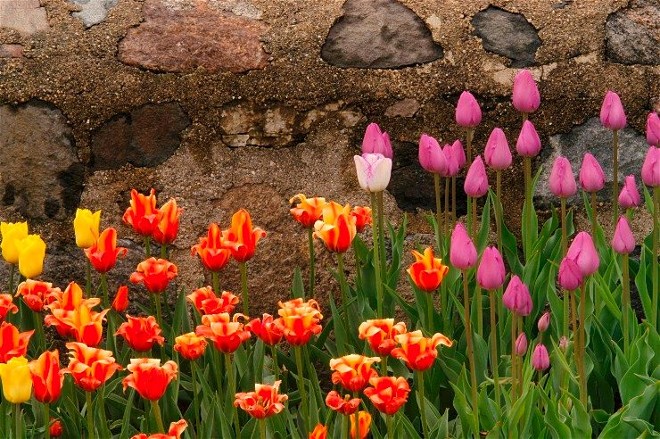
For this second picture my thoughts were completely different. Firstly I used my 75-300mm lens set at 190mm in order to isolate the Geranium and narrow the view of the background. I then used my depth of field preview lever to ascertain that my first f stop choice of f 16 gave so much detail to the background vegetation that the scene became confusing to the eye and took my attention away from this beautiful blossom. A switch to f 5.6 did not provide enough DOF to cover focus on the Geranium itself. A compromise of f 9 was just what I wanted. This aperture not only allowed the focus to cover the blossom but showed the background leaves with enough detail so the viewer would see them, but rendered them soft enough that they were not distracting. From an exposure standpoint I could have achieved the same thing with any f stop by simply changing shutter speeds, but this would have given me a completely different composition via less or more depth of field.
I have photographed this scene of Virginia Bluebells around the trunk of an Oak tree several times over the years. I am very limited in my compositional choices at this location. I compose my shots of this subject more by feel than by rules. When I made this image I specifically wanted only a small amount of trunk showing, and a slice of the opening in the woods in the upper left hand corner. I made this shot with my 18-70mm zoom set at 25mm and an f stop of f 22 in order to show all of that real estate and to render it all sharp. My camera was very close to the foreground flowers.
Wildlife images need to be composed too. It is just as important as landscapes and macros. You are somewhat at the mercy of the animal and the environment, but you would be shocked at how much difference moving a few inches in either direction will make in your comp. In many cases with wildlife you will be shooting an image that will be composed after you get home by cropping the picture. If I know that is what I am going to do I will then put my animal in the middle of the picture frame. That is of course counterintuitive to the rules of comp but I want as many choices as possible when I get home.
The two photos below of a male Redhead Duck are consecutive images. They are minor crops but most for the most part the comp was decided when I made the picture. The top picture was actually the second of the two and was made as the duck swam closer. I have never liked this picture. It is a good detailed picture of this species but it is so close that the bird has nowhere to swim. He is boxed in a photographic cage. The second ( 1st one taken) shot has room for this duck to swim and to breathe. He has been set free. Notice that when you leave some room in the direction an animal is looking or moving, it does not mean the bird has to be a perfect profile within the frame. Composing an animal a bit towards the top or bottom of the frame will make a more engaging picture. This works nicely when photographing birds in open water or clear sky. The picture of the “boxed in” bird can probably be saved by cropping to the head and body of the bird. In other words a close portrait that shows only parts of the bird and nothing else.

The next picture is a crop. Panoramic format images that require digital stitching would mean the animals would have to remain in the same exact position during a series of consecutive pictures. These Horned Grebes were fairly cooperative but not that much. My original composition is what you see here without the pano. It is the correct ( I believe) comp of two birds turning and looking at each other, but all of the open water made for a low impact picture. This narrow comp has balance to it and brings you a little closer to the birds. No rules here just instinct and experience.
A sea of grass is just as good as water or sky when it comes to being fluid with composition. Here is a case where my subject (Northern Flicker) was moving and I needed shutter plenty of speed 1/1000 sec., to stop the motion. This left me with an aperture of 6.3 and the background grasses out of focus. You are saying ha,ha, I told you shutter speed is important. Well yes it is, but when my first instinct is to dial in less aperture to get my shutter speed higher I am now as always thinking of f stop first and foremost. The adjustment of the f stop to achieve a different shutter speed will become easy and even automatic. With this shallow DOF I had to make quite sure that my focus was on my subject. I had compositional choices here beyond DOF. I chose to leave the bird lower right in the picture frame because the bird was looking upper left.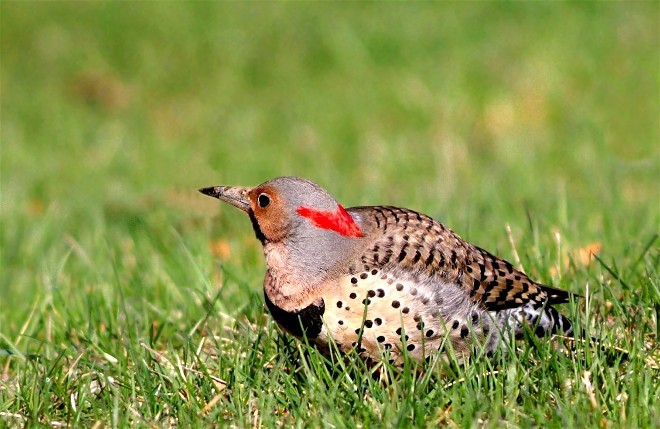
In my Photography 101 post I explained that at times I like to break the rule of thirds concerning land and sky and leave “just a kiss’ of sky or land. I gave my reasons and showed two examples. The image below was made many years ago using that mind-set. This is the 1700s San Xavier Mission outside of Tucson Arizona. The picture was made at sunrise. Now if this mission would have been located at the top of a mountain, I surely would have been happy. A mission sitting high in the sky collecting the first rays of light would have been brilliant. I would have likely placed my subject high in the frame to emphasize its location at the top of a mountain. It sits in a valley and my view was looking slightly down on the church. I elected to show mostly sky with the morning sun lighting the mission at the bottom of the frame. I do think this image has impact and it has been published. The fact that the light hits the building’s roofs balances all of that sky which is mostly single toned.
Learn the rules and then learn to break them.
 Earth Images Blog by Wayne Nelson
Pingback: Clean & Simple | Wayne Nelson's Earth Image's Blog