By
RON TOEL
Around the world the open country is reflected in many terms that is used for them: prairie, steppe, veldt, savanna, pampas, campos, and llanos. This is partly due to the different languages in different regions. Open country does vary in appearance and in fauna and flora in different parts of the world. “Prairie” implies tall grass, “Steppe” implies short grass, and “Savanna” is tropical grassland . No matter what it is called it is dominated by members of that plant family …….Grass……one of the largest families of plants.
Grasses seem to be adapted to being eaten by animals. In perennial grasses, the stem is usually under ground or closely pressed to the ground surface and the leaves can be eaten without damage to the plant itself. Even where there are no underground runners, the leaves can be cut without killing the plant. Those who are lawn mowers can vouch on that.
There is a positive advantage for the grasses being grazed. The other plants are stunted or killed when cut off, but the grasses grow back faster and stronger and over take the other kinds of plants. Without man’s intervention, the balance of grasses, herbivores, and carnivores seems to work nicely.
The first order consumers (plant eaters) actually represent a small number of the animal diversity. It is AMAZING how few of the animals can digest leaves. There are a few snails, various insects mostly in juvenile stages, and grazing mammals. Certain tortoises and land crabs, eat fallen tree leaves, along with the panda eating bamboo, the koala eating eucalyptus, and the sloths of South America, and the giraffes that browse on leaves. These are the exceptions.
The difficulty with eating leaves is the cellulose material in the cell walls of plants. To digest the vegetative matter, an animal must either have a special enzyme in the digestive tract, or have a symbiotic relationship with a cellulose digesting microbe, or have some method of reducing the leaves to a fine pulp. Most herbivore combine two of these three methods to aid in digestion. The grazing mammals, (cud chewers) have the teeth built for grinding the grasses, but also have cellulose digesting organism in their stomachs or intestines. In the ruminants, most cud chewers eat the grasses and then lie down and regurgitate what they have eaten so as to rechew the grass. The leaves then go through a fermentation process for the animal to gain the nutrition. In the horses the digestion is carried out by bacteria in the intestines. In hippos and kangaroos, special pockets in the stomach hold cellulose digesting microbes. The digestive tract is much longer than animals living on other diets, thus allowing the digestive process to be completed. Grass may be hard to digest , but it does not run away……the problem for herbivores is not to find food, but to avoid becoming food of the carnivores.
In open country there is no place to hide unless the animal is very small. One such way of hiding is to burrow. It is well developed by such as the prairie dogs, and badgers. Keen eyesite is also a must in order to stay alive. The pronghorns have developed this strategy. Sheer size and bulk can also be protective as is shown by the elephants and rhinoceros. Bison can also be placed in this category, however they can be harvested by grissley bears and wolfpacks. Speed is also a must to survive. Again the pronghorns and antelopes are tops in this category. Finally, togetherness is also a means to survive. Many eyes are better than one to spot the predator. There is safety in numbers. Herding characterizes the open country animals.
Of all the grassland around the world, the ones of Africa support the most diversely varied species of any place on our planet. No other place supports so many species of mammals, both herbivores and carnivores. Even with this varied group of animals there is very little competition for the plants that prevail. They mostly all occupy a different niche in the open country. The giraffes eat from the trees and shrubs which are out of reach from the others. Hippos graze close to the streams which gives them a special niche. They usually lay in the water by day and graze by night. The elephants eat from shrubs and from the grasses. The remainder, antelope family members (bovine) and zebras, are all in the same niche, however, their size determines access to the grasses available for them. The dik-dik can go into the shrubs where the wildebeast and cape buffalo cannot go. These herbivores also tend to shift their grazing habits with the changing seasons. They follow the lushness of the grasses, and in doing so, this migration allows the grassland to support so many animals without overgrazing. This balance is also dependent on the predators.
One tends to think of the lions, when the African grasslands are discussed. They tend to be solitary hunters along with the other felines of Africa. Also the tendency to think of the larger mammals as their prey, but there are many smaller cats and many types of small rodents available for them as well. These rodents too, are herbivores. The other hunters, as in the canine family, tend to hunt in groups. They either gang-up on their prey or act as scavengers to help clean up the kills. There are many species of birds that prey upon insects, rodents, and snakes. Snakes are both predator and prey.
Two other things are necessary for this biome to exist. They are fire and water. Fire burns all the dead material and cleans the prairie of the undesirable plants and shrubs. Water in various quantities is the livelihood of life everywhere, no matter what the continent or what niche, it is found and necessary for life. Different grasses have different requirements for water, and thus all have different specifications for it to survive. Naturally the soft green lushness of grasses needs more water than the dry brown grass.
Photos by Wayne Nelson
Shooting Star & Prairie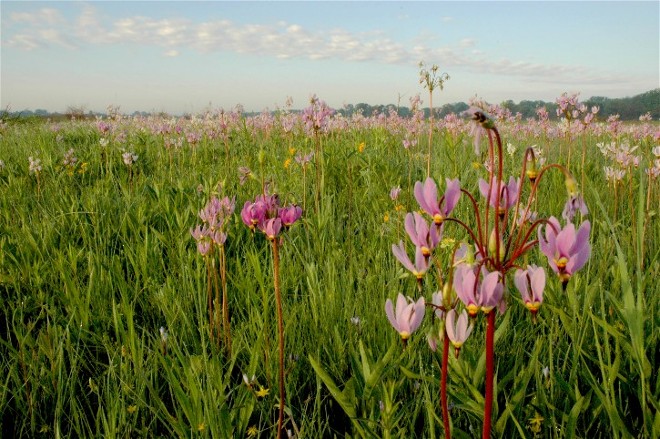
Foxtail Barley Grass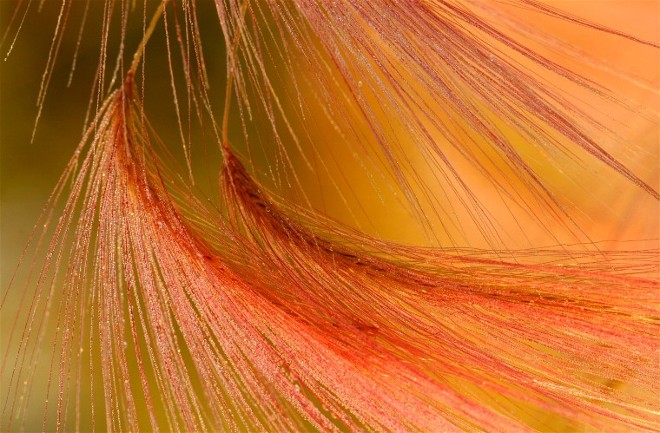

Prairie Coneflower
White-tailed Jackrabbit
 Earth Images Blog by Wayne Nelson