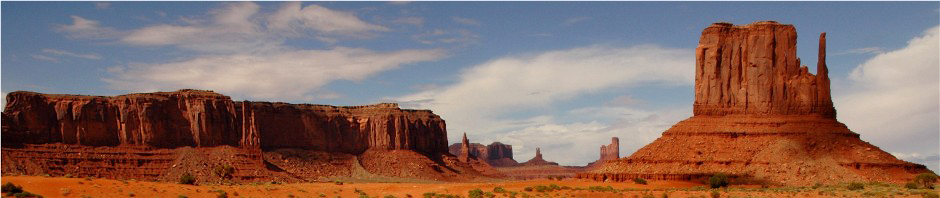
Landscapes are the easiest of the three (scapes, wildlife, macro) major types of nature photography.
Landscapes are the hardest of the three major types of nature photography.
Both of the above statements are true.
As a subject, the land can be seen right outside of your car window. It doesn’t run or fly away. You do not (normally) have to stand on your head and shoot upside down and backwards like we all seemed destined to do in macro photography. The problem is, what do you do with all of that land. I mean a bird or a mammal, well you can narrow your subject down pretty easy. If you want a picture of that flower, the primary theme and subject of your photo is set.
I spent one full day at Monument Valley Utah/Arizona and was fortunate to have had a variety of light and sky conditions to work with. Still the picture below is the only one that made its way into a commercial calendar. It is truly an odd composition. The foreground brush is a traditional comp method but not usually right in the middle of the frame. The “grand scenic” style of leading you to the distant rock forms is classic imagery except that they are spread so far off to the edges of the picture frame. Storms also usually don’t sell but in this case the distant rains are more desirable than extremely black skies. Having picked my image apart, this photo still does work. Maybe luck is more important than skill?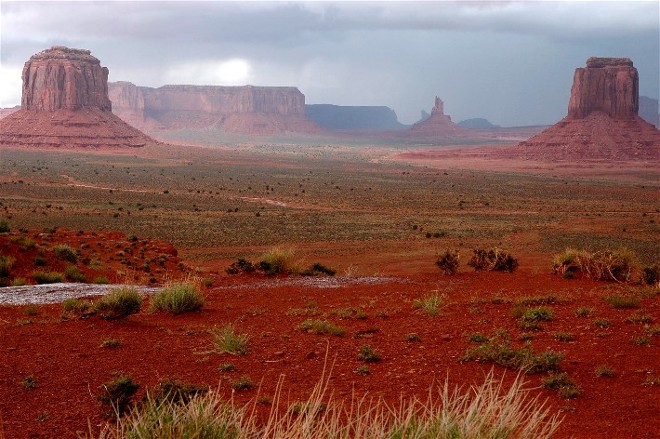
Another MV landscape. This one is under very different light conditions. We were fortunate to have five very distinct light conditions in our one day here. Using flowers in the foreground of a landscape is pretty normal stuff. You don’t however usually see one small flower as the foreground set. This is certainly a top ten MV image as far as popularity. The reason that one flower works is that this is a sparse and tidy landscape. It is so simple that it is almost neat. That fact makes that single flower prominent. 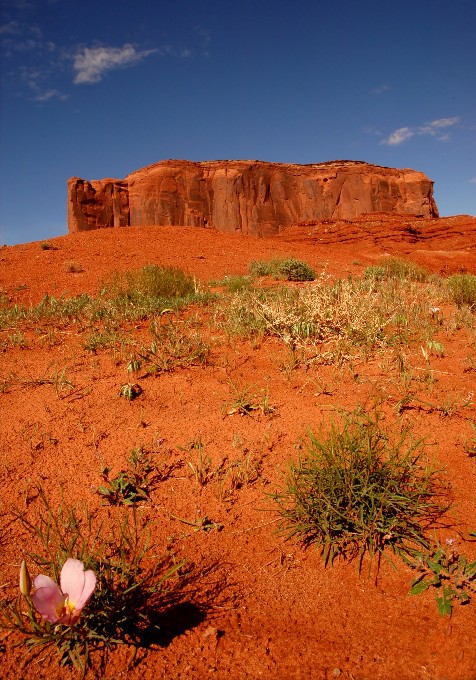
Below is yet another way to use flowers at the beginning of a landscape picture. This image was made in the Badlands of South Dakota. Among the dozens (hundreds) of images I have shown from this location, with this one I chose not to feature rock forms. This image is more about sunflowers and Buffalo Gap National Grasslands than it is about the Badlands. Always make as many different types of images and comps as you can when you visit a great location. If you pursue one area of a location, or one style of imagery you may be very happy with your work. That is for a few weeks or months. After all of these years of sharing pix from this location there are still more images to show. 
Leading lines are used to draw you into a picture and towards a major subject such as a mountain or a manmade building. It usually pays to think outside the box and leading lines can also be used to take you on a journey out of the picture to places unknown. Mystery is a powerful tool in landscape photography. Shadows and “leaving lines” are two methods of accomplishing this. This is The Black Canyon of The Gunnison, Colorado.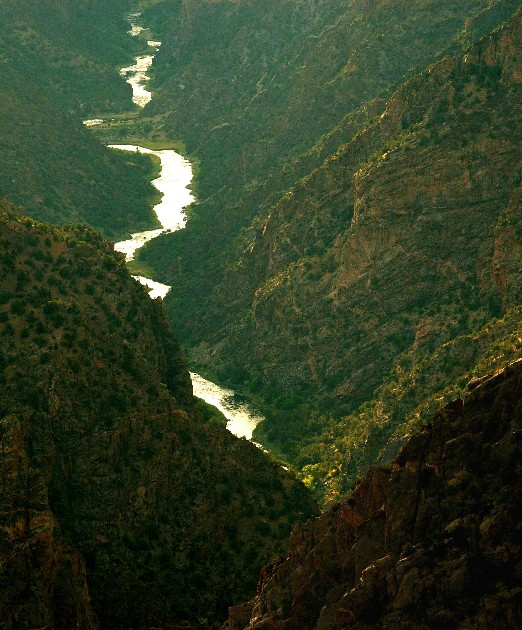
The comp in this picture works because of the light. The low angle and very directional light of dusk allowed me to carve out and feature a small corner of the top cliffs of Black Canyon.
Aerial Perspective, is a truism to be embraced in the mountains. Painters use this as well. The closer the mountains get to the viewer the darker and more detailed the land will become. When you get to the spot closest to the camera your subject may get dark to the point of once again, losing detail. Adding a bit of contrast after you get home will push this effect a little farther. Once again this is Black Canyon, CO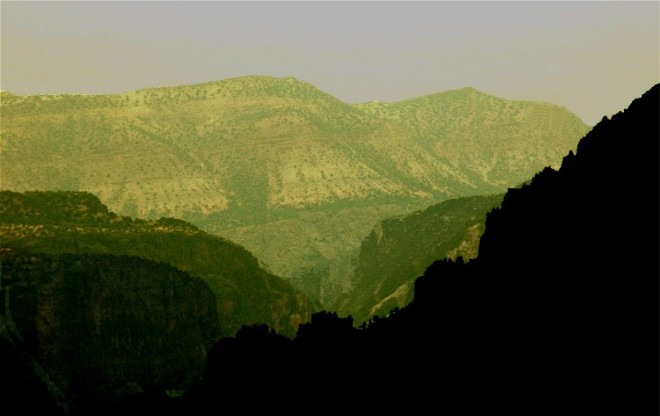
Devil’s Tower Wyoming is an interesting place. It is also hard to make creative comps here. I arrived in the vivid light of morning and immediately framed a golden shot of the tower with trees on both sides. The photo was made from the parking lot at the visitor’s center. I roamed the near-by area making photographs of Pronghorns and Elk and then returned in the afternoon. The light was warm but muted. I first drove and then hiked to the backside of the tower looking for a new, more open perspective. There was not a lot to do except let the tower grow out of the foreground field. The one thing that I could do is keep the rock form out of the middle of the picture frame. I decided to place it as far to the right as possible. The tower basically leans a bit to the left, or back into the picture frame. That makes this photo more interesting than it otherwise would be.
Morgan Falls in Wisconsin is an inner-forest waterfall. You are working in the tight confines of rock, water and trees. I use lenses from 18mm-300mm at MF but even at 18mm I am usually working up very close and tight to rock and water. Wide angle lenses are marvelous for helping you spread out the land. They can be (and it was here) used to give you some visual freedom and also to include information about the nearby landscape.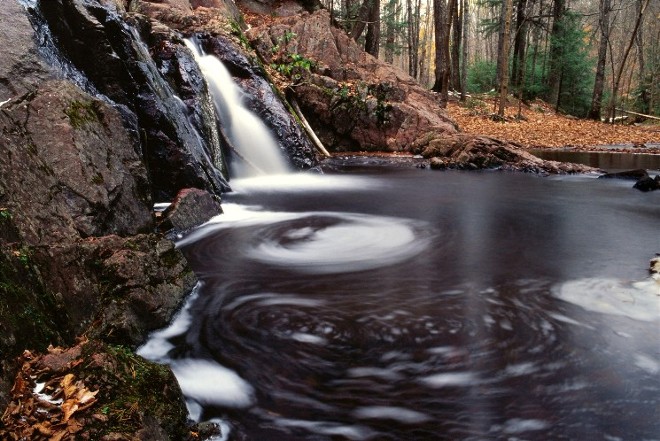 Recently I have been showing a bit more of man’s handiwork in my posts. My secondary subject is history and old buildings. The pictures below are from Scenic (the name of the town) South Dakota. This western SD town is as close you can get in this day and age, to a genuine (not tourist created) old west town. I first came here many (many) years ago with my parents. Hours of dirt highway, yes a highway still made of dirt, brought us to Scenic. In the 2000s I traveled here once again on a now paved, yet very quiet country highway. I don’t make a lot wide-angle stretch shots of historic architecture. I like details in this type of photography. Actually the first shot is in fact almost the entire town. The second image takes you into the life of a building that “once was”. It was quite in Scenic that morning and only a barking dog was to ne heard or seen.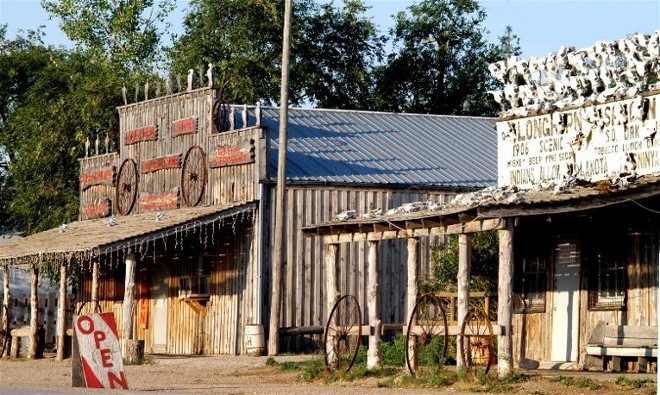

Our last image does not feature manmade objects but incorporates one into what is basically a nature photograph. The river actually leads you not into infinity as the Black Canyon shot does, but to all of those golden leaves and the bridge itself. Sometimes I make my images here shooting along the bridge and into the forest. That of course makes the bridge itself my leading line.
We all evolved from people who worked with the land. It is the essence of existing on our planet. It is also the foundation on which all nature photography rests. For the photographer, the land ( and sea & sky) carries with it the contradiction of having complexity and simplicity at the same time. We have an endless number of choices to make. What to leave in, what to leave out. There are rules to be followed. There are rules to be broken. The art of working with the land will make you a better wildlife photographer and a better close-up photographer as well. When you develop a fondness for the land, the plants and animals will follow it into your heart.
I promise.
 Earth Images Blog by Wayne Nelson