The short answer to the question above is yes! For me it was worth the wait.
I got up early on a summer’s day in 1990. This would be the one day (had a day job then) I would be able to head the 40 miles to a Walworth county woodland to photograph the invasion of the 17 year Periodical Cicada. Then I looked outside at the rain and fog. I stayed near home and made fog pictures instead. I never did make that trip.
In early July of 2007 (yes 17 years later) I was reading a news report on the internet about a Midwestern (Wisconsin) invasion of the Periodical Cicada. I wondered if I should attempt to get pictures. I’m not a math wiz but a brief calculation told me that it would be 2024 before their next hatching. I was afraid if I waited until their next visit I would not be around to make pictures. The news told me that the largest brood in Wisconsin was at Wyalusing State Park on the Mississippi River. That would mean a trip from my Lake Michigan shores home, all the way across the state to photograph a bug. What the heck. Life is short.
All of my Mississippi River photo trips start with a visit in the darkness to Iowa’s Pike’s Peak State Park. It gives a perfect view of the mating of the Mississippi and Wisconsin Rivers. Add the colors of sunrise and it is a great way to start the day. Wyalusing S.P. is right across the river so off I went to meet up with my red-eyed little monsters. I reached the entrance shack for the park and noticed the hummingbird feeders and the prairie flowers were doing an incredible business. Hundreds of Ruby-throated Hummers were partaking of nectar and sugar-water. This required about 30 minutes of my time. That’s when I heard it. Now I have heard cicadas and locust before, but nothing like this. The sound was deafening. An unbelievable whining sound that would rise and fall in pitch. Hearing a noise like that and finding the groups of insects could be two different things. I decided to head into the open wooded areas and see if I could find a group that was just out all fresh and new. I hit a home run with the first location that I stopped at. I found one large group of bush like plants covered with cicadas and also with what they leave behind.
A pregnant female cicada will slit the branch or the bark of a (usually deciduous) tree and deposit her eggs there. The hatched nymph will work its way down into the soil beneath the tree until it finally reaches the roots. It will feed on sap of those roots for the next 17 (there are some 13 year cicadas) years. Like magic when the proper time has elapsed the nymphs will crawl out of their dining room until they reach the first above ground perch they can locate. They will then split the back of protective covering of skin and crawl out to warm up, find a mate and start all over again. I observed Bluebirds and others having a feast on the cicadas, although the sheer numbers of them would mean that 2024 would be another good year. There are 14 known broods of the 17 year Periodical Cicada in the world.
This was the plant group that I found my cicadas warming on. Each insect is a little over an inch in length.
Their first job after they re-enter the outside world is split the back of their exterior skin and crawl out. My job was to show the skin and the split. To inform and educate. 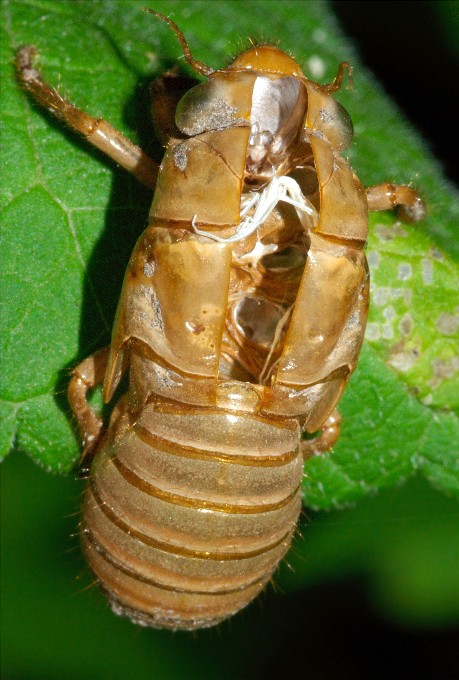
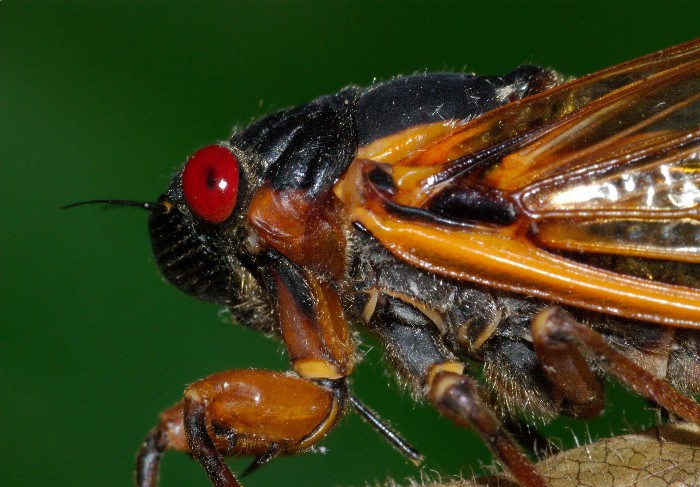
I of course needed some straightforward images of my subject. I wanted them to be up close and with detail. Heavy shade and a persistent wind meant that I had to use flash for all of these images. I used TTL capabilities to balance that flash. As I was making pictures it occurred to me that up close, they looked a bit like they came from a bad 1950s Japanese horror film.

We end where we started. Remember this is all about a never ending (hopefully) cycle. 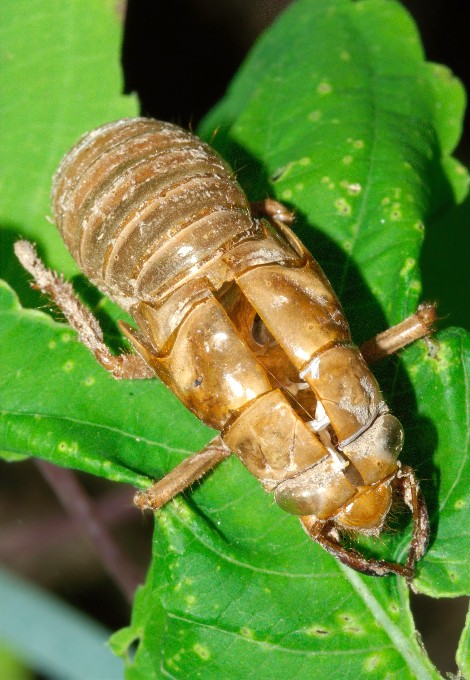
I love all of the stories in nature. The large and the small. Macro photography of insects and other little things has both brought back childhood memories of my days of discovery, and created an educated adult as to the ways of the natural world. I know that not every photographer will want to photograph all of the creepy-crawly things that I do, but even if you stay in the world of butterflies and dragonflies you will be shocked at what you will find, and what you will learn.
True confessions. If I had been on a paid assignment that morning shoot would have been more failfure than success. I would have spent at least the whole day here and might have stayed until everything to do with the Periodical Cicada was over. I would have wanted images of them mating. I would have wanted pictures if the females laying eggs or at least of the eggs in those wood splits. Nymphs crawling to the dirt if possible. The holes they crawl out of and actual images of the adults immerging from their skins. Maybe a shot of a Bluebird with a cicada in its mouth. That is photojournalism. The truth is time was short and I was just shooting for myself. I did persue those other shots but not for very long. Whatever stock images I could get was what I lived with. It was a great educational morning and no matter what else I do nobody can take away my 17 year pictures.
I love creating stand alone artistic imagery and story telling photos equally. I could never choose one or the other. In fact my most enjoyable days find me going back and forth between the two displines. My favaorite images do both at the same time.
Bonus Shots
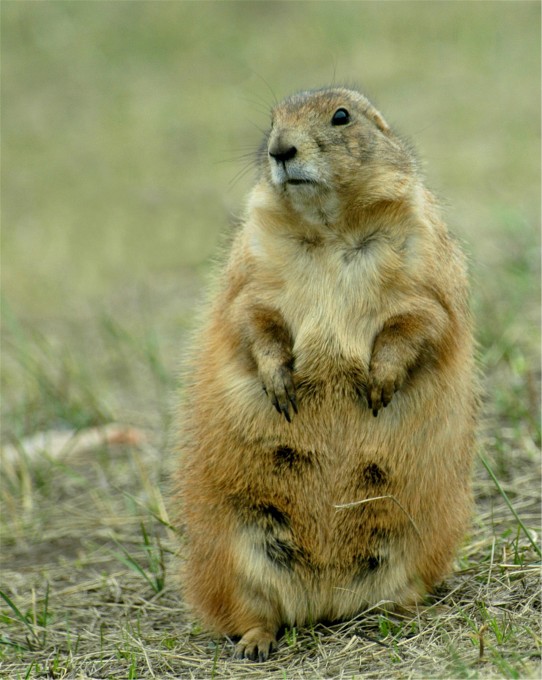
This week’s bonus shots are of two subjects that I should have shown in previous posts. I have shown you male Sharp-tailed Grouse (and 1 Prairie-chicken) dancing their courtship ritual but never showed a female. Our first image rectifies that. I have shown images of and sang the praises of the White-tailed Prairie Dog without showing any images of the more common Black-tailed Prairie Dog. The second picture of a Black-tail may be a very pregnant female. Both images were made in western North Dakota. 
I thank you and please stop back,
Wayne
 Earth Images Blog by Wayne Nelson